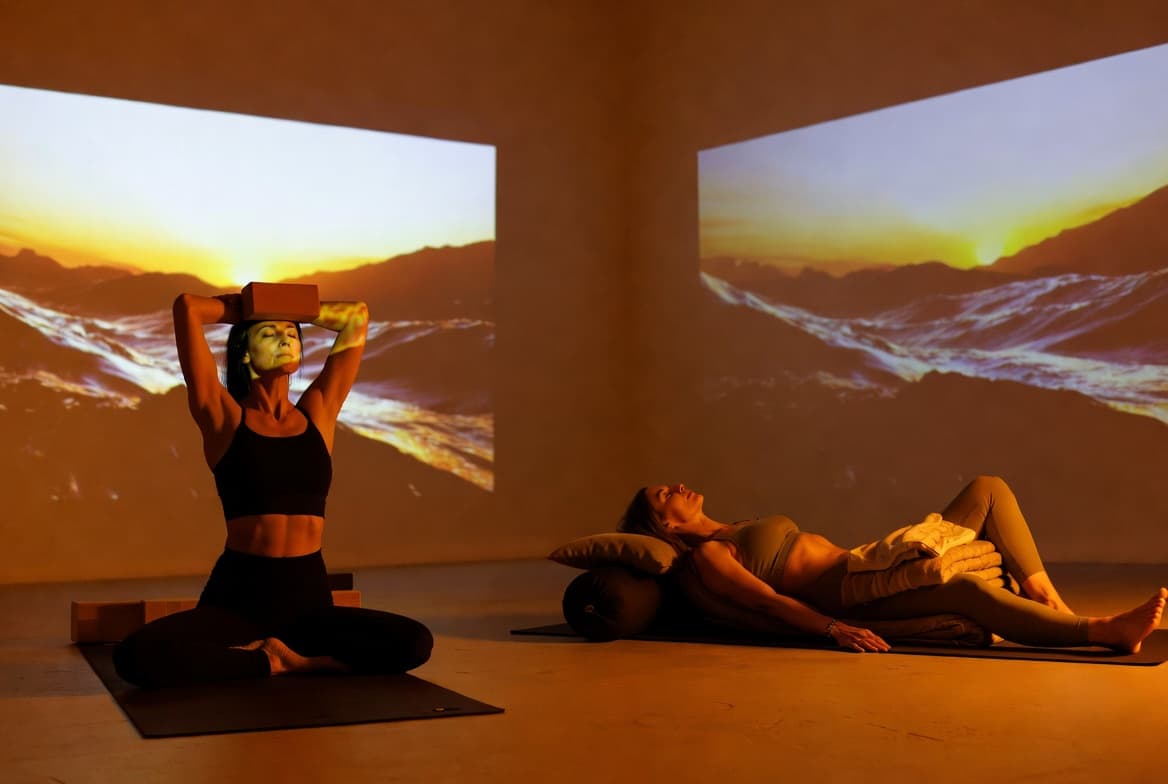
Yin yoga and restorative yoga are the two yoga styles most often confused with each other. Both are slow. Both involve long, held poses. Both feel deeply relaxing compared to vinyasa or power yoga. Walk into either class and you'd see people lying still on mats, looking about as peaceful as it gets.
But they're different practices, and they produce different outcomes. Yin deliberately introduces stress to connective tissue — you're supposed to feel something. Restorative aims to remove all stress — you're supposed to feel nothing. The poses look similar. The intent is opposite.
Here's how to tell them apart and pick the one that matches what you need.
The Core Difference
Yin yoga targets the connective tissue — fascia, ligaments, joint capsules — by holding poses at the edge of sensation for three to five minutes. The muscles stay soft so gravity and time apply sustained, mild load to deeper tissues. You're looking for a working edge: not painful, but not comfortable either. The tissue adapts because it's being asked to.
Restorative yoga is about complete parasympathetic rest. Every pose is fully supported by props — bolsters, blankets, blocks, sandbags — so that nothing in the body is under load. Muscles are off. Connective tissue isn't stressed. Holds run five to twenty minutes, long enough for the nervous system to fully downshift. The goal is deep rest and recovery, not tissue adaptation.
One is a practice that asks you to stay with sensation. The other is a practice that removes sensation so you can fully let go. Both are valuable. They're not interchangeable.
Side-by-Side Comparison
| Yin | Restorative | |
|---|---|---|
| Goal | Stimulate connective tissue adaptation | Activate parasympathetic recovery |
| Prop use | Moderate — used when needed | Extensive — every pose fully supported |
| Sensation target | A working edge (mild discomfort) | None — fully comfortable throughout |
| Hold length | 3–5 minutes per pose | 5–20 minutes per pose |
| Muscle engagement | Passive / off | Fully off |
| Body position | Moderate shapes with some intensity | Fully reclined or supported shapes |
| Breath focus | Breath through sensation | Breath for deeper relaxation |
| Heat generated | Low — external heat can help | None — room temperature or cool preferred |
| Class length | 60–75 minutes | 60–90 minutes |
| Typical poses | 8–12 per class | 4–6 per class |
| Best for | Flexibility, tissue health, recovery | Nervous system reset, injury recovery, deep stress release |
| After-class feeling | Loose, slightly worked, calm | Profoundly rested, almost drowsy |
Choose Yin If You Want To...
Improve flexibility at a deep level. Active stretching improves muscle elasticity. Yin's sustained load on connective tissue produces flexibility gains that muscle work can't reach. If you've been stretching for months and your range of motion has plateaued, yin is often the unlock.
Address tight hips, lower back, or shoulders. These are the areas where connective tissue accumulates tension from repeated use — running, cycling, sitting, lifting. Yin's long holds directly target the fascia and joint capsules around these areas in a way no other practice does as efficiently.
Recover from active training without fully stopping. Yin is a middle ground between training hard and doing nothing. You're working, but in a direction that supports your other training. For athletes, runners, and hot-yoga practitioners, yin is the recovery practice that actually produces adaptation rather than just rest.
Build tolerance for discomfort. Sitting in a pose with mild sensation for five minutes trains the nervous system to meet discomfort with steadiness instead of reaction. That skill carries into stress management, recovery from injury, and dealing with difficult emotions. This is the quiet gift of yin that most practitioners don't expect.
Choose Restorative If You Want To...
Reset a fried nervous system. Chronic stress, burnout, insomnia, anxiety — restorative yoga is designed for these states specifically. The deep prop support removes the muscular tension that keeps the nervous system on alert. After 20 minutes in a fully supported pose, the body has almost no choice but to downshift.
Recover from injury or illness. When yang practices are off-limits — post-surgery, during acute injury, during severe illness or burnout — restorative yoga is often the only appropriate movement practice. The total support means nothing can be aggravated.
Sleep better. Restorative is one of the few practices with meaningful documented effects on sleep quality. A restorative class before bed, or an evening restorative practice 2–3 times a week, tends to produce measurable improvement in sleep onset and sleep depth within a few weeks.
Feel nothing and be okay with that. Restorative isn't about accomplishment. It's about permission — permission to do nothing, to need nothing, to be fully supported. For many people (especially high-achievers and people who struggle to rest) this is harder than any workout.
What ALIVE Offers (and Why Heat Changes the Restorative Question)
ALIVE's class menu doesn't include something labeled "Restorative Yoga" in the traditional sense — no dedicated 90-minute class built around four fully-propped poses in a cool studio.
What we've found in practice is that heated yoga, done right, produces much of the restorative outcome members typically go to restorative classes for. The warmth itself activates the parasympathetic system. The slow pacing and long holds deepen the effect. Members leave noticeably regulated, rested, and nervous-system-reset. That's the restorative result — delivered through a slightly different mechanism than traditional restorative yoga uses.
Aura (Yoga Calm) is the clearest example. It runs at 92°F with gentle pacing, longer holds than most flow classes, and a fully calming intent. It's not strict yin and it's not strict restorative, but experientially it delivers what members seek from restorative practice: deep rest, parasympathetic reset, a sense of being fully restored. Many ALIVE members describe Aura as the most restorative class on the schedule.
Neutron is not on the ALIVE schedule right now. Aura (Yoga Calm) at 92°F is the yin-style class you can book today, and it is what the recommendations below point to. Neutron (Yin Yoga) at 85°F is our yin practice — but the low heat and long holds produce a significant restorative effect as a by-product. You get the connective-tissue work yin is known for, and the parasympathetic downshift at the same time. For people using yin partially as recovery and partially for tissue adaptation, Neutron covers a lot of ground.
The traditional distinction between "yin" and "restorative" — tissue load vs full support — matters for classification. But from the member's perspective, the question that really counts is: "Do I leave feeling restored?" Both Aura and Neutron answer that question well, with Aura leaning more toward the restorative outcome and Neutron leaning more toward the tissue-adaptation outcome.
If you've tried traditional room-temperature restorative and want to see what the heated version of that outcome feels like, Aura is the class to take first. If you've done yin in cool studios and want to see what warmth adds, Neutron is the right entry.
Can You Do Both?
Yes. They complement each other beautifully, and many people who develop a deep yin practice also make space for restorative once or twice a month — especially during periods of high stress, after illness, or during travel.
A reasonable weekly cadence for ALIVE members looking for both outcomes:
- 2–3 Aura classes per week for the yin-style work and the restorative outcome
- 1–2 Aura classes per week for the restorative outcome — parasympathetic reset, deep rest, nervous system recovery
- Plus whatever else you do — vinyasa, hot yoga, strength, cardio
If you specifically want traditional room-temperature restorative (long 20-minute fully-propped holds in a cool space), a dedicated restorative studio can complement what ALIVE offers. Most members find Aura covers enough of the yin-to-restorative spectrum without needing a separate studio, especially once they've experienced how much the heat amplifies the calming effect.
What About Heated Restorative?
Some studios offer heated restorative classes. Opinions vary on whether this is authentic to the tradition. The traditional argument against heat: restorative is supposed to be about deep nervous system rest, and heat adds a sympathetic (activating) stimulus that works against that goal.
The argument for heat in a restorative-adjacent context: at moderate heat (85–92°F), the warmth itself can activate the parasympathetic response, and the muscular release happens more fully than in a cool room.
Our experience at ALIVE with heated yin (85°F in Neutron) is that the warmth helps rather than hinders the calming effect — but that's specifically for yin, where mild load is already part of the practice. We'd be hesitant to recommend heated restorative in the 98+°F range. If heat is added, somewhere in the 80s is the right place.