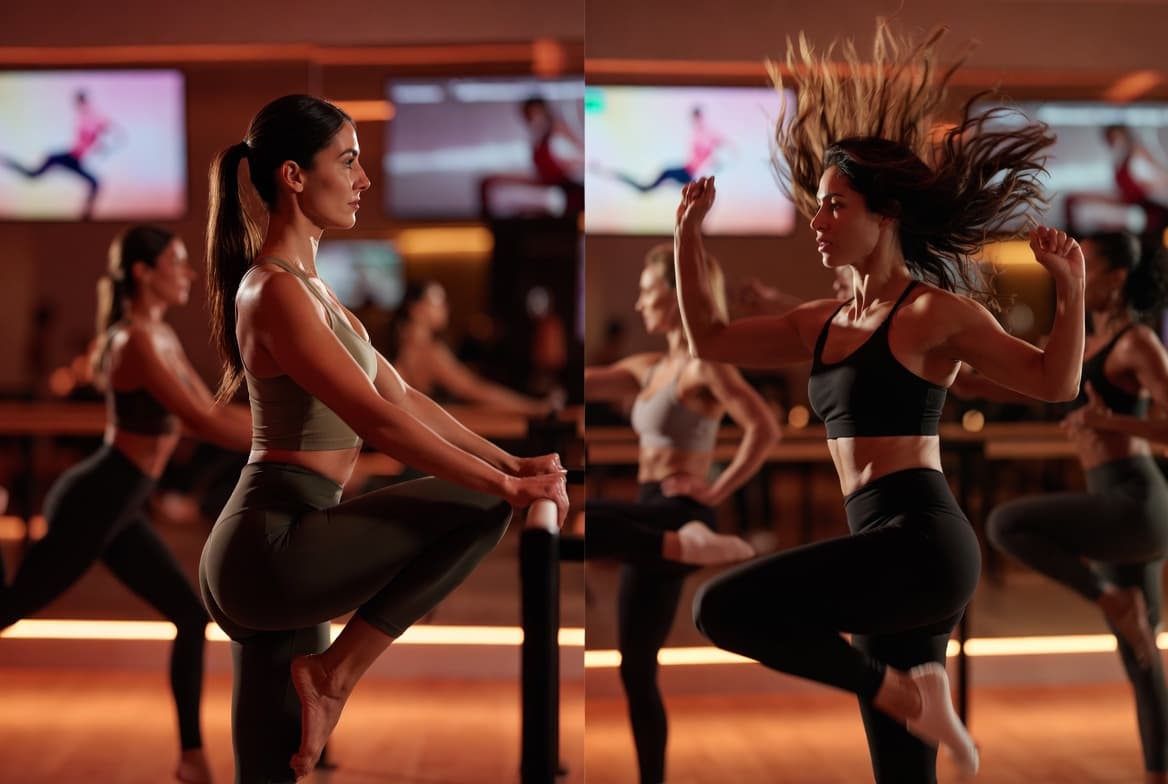
Walk into two different barre classes and you might think you're doing two different workouts. That's because you are — cardio barre and traditional barre share the ballet barre and the fundamental movements, but the pace, intensity, and goals are distinctly different.
Here's how to tell them apart and when to choose each one.
Traditional Barre
Traditional barre is slow, precise, and built around isometric holds. You hold a position — a plié, a relevé, a bridge — and make micro-movements within that hold. Pulse an inch up, an inch down. Hold for 30 seconds. Hold for 60 seconds. Repeat until the muscle is trembling.
The pace: Deliberate. The instructor cues slow, controlled movements. Music is steady, not driving. Rest breaks are short but intentional.
The goal: Muscular endurance and sculpting. Traditional barre fatigues slow-twitch muscle fibers through sustained tension, creating the lean, toned look barre is known for.
The feel: Burning. Shaking. That deep, localized heat in your thighs or seat that tells you the muscle is at its limit. It's not breathless — it's intense in a quiet, focused way.
At ALIVE: Spark (Total Body Barre) is the traditional barre offering. Full-body sculpting with isometric holds, heated to 85°F.
Cardio Barre
Cardio barre takes the same fundamental movements and speeds them up. Pliés become jump squats (or rapid pulses). Standing barre work gets dance-inspired transitions. The pace picks up, your heart rate climbs, and you're sweating from cardiovascular effort, not just muscle fatigue.
The pace: Fast. Music drives the tempo. Transitions between exercises are quick. You move from standing barre work to floor work to standing again without long breaks.
The goal: Calorie burn and cardiovascular fitness combined with toning. Cardio barre bridges the gap between a strength class and a cardio class.
The feel: Breathless. Your heart rate stays elevated for most of the class. You still feel the barre burn in your muscles, but there's a cardio layer on top. You'll sweat more, breathe harder, and feel the workout in your lungs as well as your legs.
At ALIVE: Particle (Cardio Barre) is the cardio barre offering. Dance-inspired, high-energy, heated to 85°F.
Head-to-Head Comparison
| Traditional Barre | Cardio Barre | |
|---|---|---|
| Pace | Slow, controlled | Fast, dynamic |
| Heart rate | Moderate (120–140 BPM) | High (140–170 BPM) |
| Primary benefit | Sculpting and toning | Calorie burn + toning |
| Calorie burn | 300–400 per heated class | 400–500 per heated class |
| Muscle focus | Isolated, deep fatigue | Broader, faster fatigue |
| Dance element | Minimal | Moderate to high |
| Sweat level | Moderate (significant in heat) | High (very significant in heat) |
| Best for | Definition, endurance, recovery days | Weight loss, cardiovascular health, energy |
| ALIVE class | Spark | Particle |
When to Choose Traditional Barre
- You want sculpting over cardio. Traditional barre builds deeper muscle definition because the sustained holds fatigue muscles more completely.
- It's a recovery day. The lower heart rate makes traditional barre gentler on your cardiovascular system — good for the day after an intense HIIT or hot yoga class.
- You prefer precision. If you like slow, controlled, intentional movement where you focus on feeling every muscle, traditional barre is your format.
- You're new to barre. The slower pace gives you time to learn positions and form without feeling rushed.
When to Choose Cardio Barre
- You want maximum calorie burn. Cardio barre burns 20–30% more calories per class than traditional barre because your heart rate stays elevated.
- You're short on time. If you can only take one class and want both strength and cardio, cardio barre covers both.
- You love energy. The faster music, dynamic transitions, and dance-inspired movements make cardio barre feel like a party that happens to destroy your thighs.
- You're training for endurance. The sustained elevated heart rate builds cardiovascular fitness alongside muscular endurance.
The Best Strategy: Alternate
Many ALIVE members rotate between both formats:
- Spark (traditional) 1–2x per week for sculpting and precision
- Particle (cardio) 1–2x per week for calorie burn and energy
- Subatomic (core) once a week for focused core strength
This gives you the toning benefits of traditional barre, the cardiovascular benefits of cardio barre, and the core foundation of targeted core work. Add hot yoga or pilates on other days for flexibility and core depth.
Both Are Better Heated
At ALIVE Studios, all barre classes are heated to 85°F with 50% humidity. The heat amplifies both formats:
- Traditional barre + heat = deeper muscle fatigue (muscles tire faster in warmth) + better stretching at the end
- Cardio barre + heat = higher calorie burn (elevated heart rate from both movement and heat) + more profuse sweating
ALIVE uses patented dew point controls so the heat never feels oppressive. You'll sweat, your muscles will work harder, and you'll leave feeling accomplished — not overheated.
Try Both at ALIVE
Classes run every 30 minutes at Plano, Southlake, and Irving.
Your first month of unlimited classes gives you access to both Spark and Particle (plus every other ALIVE class). Try each format in your first week and see which one you reach for more.