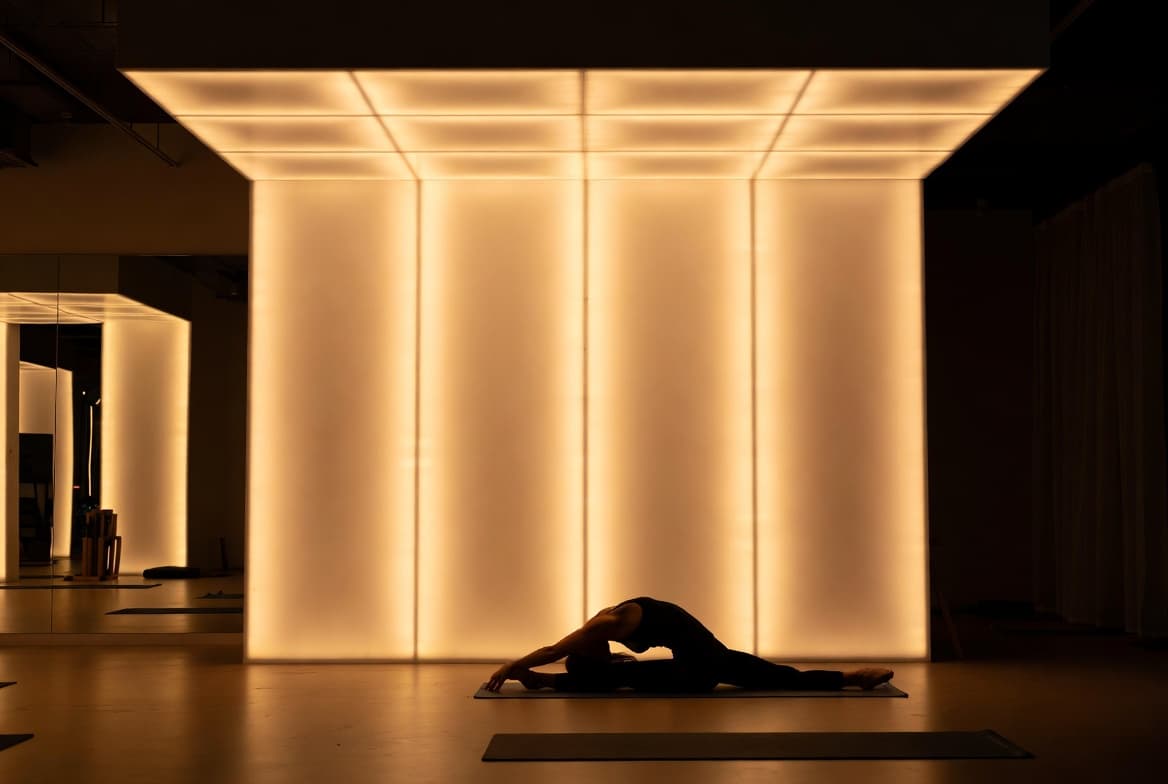
Both infrared yoga and traditional hot yoga put you in a heated room, get you sweating, and deliver real physical results. But the way the heat reaches your body is fundamentally different -- and that difference changes how the practice feels, who it works for, and what happens inside your muscles and joints.
If you're still sorting out the basics, start with what hot yoga is and how it works. This article assumes you know the foundation and want to understand the heating methods.
How Traditional Hot Yoga Heats You
Traditional hot yoga uses forced-air heating systems -- essentially, powerful HVAC units that push hot air into the room. The air temperature rises to 95-105°F, and humidity is controlled (typically 40-60%) to manage how that heat feels on your skin.
When you walk into a traditionally heated studio, the sensation is immediate. The air is thick and warm. Your body begins sweating quickly because the ambient temperature forces your cooling system to activate. The heat warms you from the outside in -- skin first, then gradually into muscle tissue. Effective, but it can feel oppressive for heat-sensitive people.
How Infrared Yoga Heats You
Infrared heating panels emit far-infrared wavelengths -- the same type of energy you feel from sunlight, without the ultraviolet radiation. Instead of heating the air, infrared panels warm objects and bodies directly. The energy penetrates your skin and heats muscle tissue from the inside out.
The result: your body gets hot, but the air doesn't feel as heavy. Room temperature in an infrared studio may read 85-95°F, yet your muscles feel deeply warmed. Because the air isn't superheated, breathing feels easier. For people who find forced-air heat suffocating, infrared can be the difference between loving and hating hot yoga.
What the Research Says
The science on infrared heating and exercise is still developing, but here's what we know:
Deeper tissue penetration. Far-infrared wavelengths penetrate 1.5-3 inches into the body, warming muscle and connective tissue more directly than convective (air) heat. This may improve flexibility with less surface-level discomfort.
Cardiovascular response. Both heating methods elevate heart rate and improve circulation. Research shows hot yoga (regardless of heating method) produces cardiovascular benefits comparable to moderate-intensity aerobic exercise.
Recovery and inflammation. Some evidence suggests far-infrared exposure may reduce muscle soreness and support joint health, though more yoga-specific research is needed.
Calorie burn. Both methods produce similar calorie expenditure. The burn comes from muscular work and thermoregulation, not the heating method itself.
For a deeper look at how your body responds and adapts to heated practice over time, read our guide on heat adaptation in hot yoga.
Side-by-Side Comparison
| Factor | Traditional Hot Yoga | Infrared Hot Yoga |
|---|---|---|
| How it heats | Air is heated to 95-105°F | Panels warm your body directly |
| Air temperature | High (matches target temp) | Lower (room may feel 85-95°F) |
| Breathing comfort | Can feel heavy, humid | Generally easier, less dense air |
| Muscle warming | Outside-in (skin first) | Inside-out (deeper penetration) |
| Sweat volume | High | High (sometimes more, due to deeper warming) |
| Energy cost | Standard commercial HVAC | Infrared panels (often more energy-efficient) |
| Best for | Those who enjoy intense heat immersion | Heat-sensitive people, beginners, anyone who dislikes heavy air |
| Calorie burn | 220-460 per session | 220-460 per session (comparable) |
| Flexibility benefit | Significant | Significant (potentially deeper due to tissue penetration) |
Benefits That Overlap
Regardless of the heating method, hot yoga delivers:
- Increased flexibility from warmed muscles and connective tissue
- Cardiovascular conditioning from the heat-elevated heart rate
- Strength building from sustained pose holds and bodyweight resistance
- Stress reduction from focused breathing and physical intensity
- Improved circulation as your body works to distribute heat
Both methods produce these outcomes. The full catalog of hot yoga benefits applies to both infrared and traditional approaches. The difference is in the experience, not the results.
Who Should Choose Infrared
Infrared hot yoga may be the better fit if you:
- Dislike heavy, humid air. Infrared rooms feel more breathable.
- Are heat-sensitive or new to hot yoga. The gentler air temperature makes the heat less jarring.
- Have respiratory sensitivities. Breathing superheated air is harder on the lungs. Infrared reduces that stress.
- Want deep muscle warming for recovery. Infrared's tissue penetration may benefit athletes using yoga for active recovery.
Who Should Choose Traditional
Traditional forced-air hot yoga may be the better fit if you:
- Want maximum heat immersion. Some practitioners love the intensity of walking into a wall of heat.
- Prefer the Bikram-style environment. Traditional Bikram studios use forced-air heating exclusively.
- Want the mental challenge. The heavier air creates a more demanding environment for building discipline and focus.
What About Infrared Saunas?
An infrared sauna uses the same radiant panels as an infrared yoga studio. The difference is that you sit still — and it is worth being precise about what that means. A sauna gives you one ingredient of a hot yoga class, served on its own.
That ingredient is real, and it deserves to be taken seriously. Sitting in a sauna raises your core temperature and heart rate, widens blood vessels, and most people find it genuinely restorative. The long-running Finnish cohort studies followed regular sauna bathers for decades and found better cardiovascular outcomes among the most frequent users — observational research, so it shows a pattern rather than proving cause, but a consistent one. Whole-body heating has also been studied on its own for mood, with encouraging early results.
Here is the part that gets lost in the comparison: a hot yoga class already contains that heat, and then adds everything else. Movement through a full range of motion. Load on muscle and joint. Sustained effort your heart has to answer. Breath and attention held for an hour. A time on a schedule that gets you out of the house. Each of those has its own body of research, and they stack.
So the honest framing is not sauna versus hot yoga as two routes to the same destination. It is one ingredient versus the whole recipe. Heat by itself makes no demand on your body, and adaptation only follows demand. A sauna warms tissue. It does not take that tissue anywhere.
We do not have saunas at ALIVE. The heat is built into the room you practice in, rather than a box you sit in afterward.
Sauna or Hot Yoga: Which Fits Your Goal?
- Strength. Hot yoga. Sustained pose holds and bodyweight loading build real tissue. A sauna offers no resistance at all.
- Flexibility and mobility. Hot yoga. Warm tissue only helps if you move it through range while it is warm. Otherwise you are just warm.
- Cardiovascular fitness. Hot yoga. Both raise your heart rate; only one of them is exercise.
- Stress relief and mood. Hot yoga, and the evidence gap here is wider than most people expect. A 2023 randomized trial from Massachusetts General Hospital and Harvard found that adults with moderate-to-severe depression improved substantially more over eight weeks of heated yoga than a control group — we cover what that research does and does not show in detail. Sauna research on mood is thinner and largely observational. A sauna is calming; the practice is better studied.
- Recovery. Both, for different jobs. A sauna is the right call when you want to add nothing at all — passive heat on a rest day. Gentle heated practice is better when you want to restore range of motion rather than only relax: at ALIVE that is Aura (Yoga Calm) or Electron (Hot Yoga Lite), both around 92°F.
- Weight management. Hot yoga, with a caveat. The scale drops after both, and most of that is water you drink back within the hour. The lasting change comes from the work, not the sweat.
If you have access to both, use each for what it is good at: practice for the training effect, sauna afterward or on off days when you want heat without a workout. If you are choosing one, choose the one that contains the other.
How ALIVE Studios Approaches Heat
ALIVE Studios uses a calibrated climate control system designed to deliver precise, consistent heat environments across different class types. The approach is engineered -- not a generic furnace cranked to 105°F. Humidity is controlled alongside temperature, which is what separates a practice room from a dry sauna: the room stays warm enough to work in and humid enough that your body keeps sweating productively, rather than baking you at one fixed setting.
Each class format operates at a specific temperature:
- Electron at approximately 92°F for an accessible, beginner-friendly warmth
- Glow at approximately 92°F for comfortable flow practice
- Atom at 98.6°F -- body temperature, the signature ALIVE experience
- Photon at 100°F+ for advanced practitioners who want peak heat intensity
Combined with floor-to-ceiling video screens and curated soundscapes, the heat becomes one element of a fully immersive experience.
Your Next Step
The best way to understand the difference is to feel it.
Browse the class schedule at ALIVE Studios and choose a format that matches your comfort level. If you're new or heat-sensitive, start with Electron. If you want the full experience, try Atom.
Find your nearest location in Plano, Southlake, or Las Colinas — all three within easy reach of the Dallas-Fort Worth metroplex — and start your unlimited trial month. You get access to every class type -- enough variety to discover exactly how you like your heat. For a full walkthrough of what to expect on day one, read our first class guide.