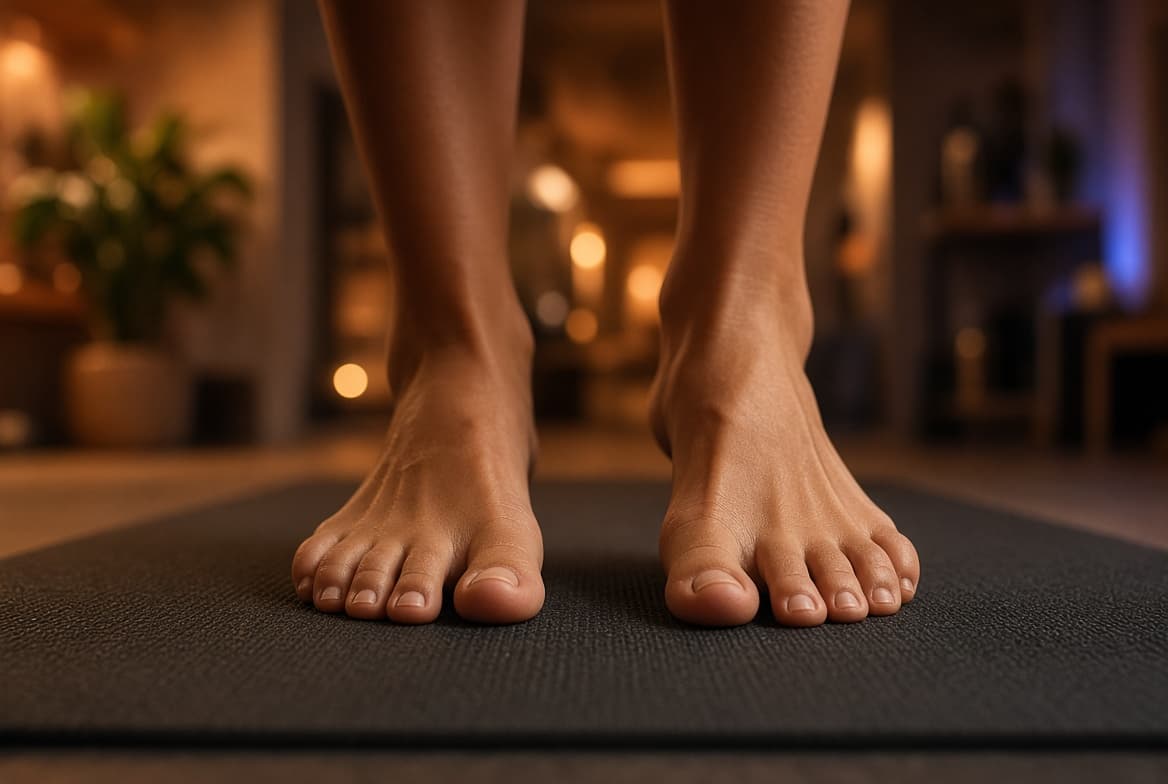
Your feet are the only part of your body that touches the ground in almost everything you do, and for most adults they spend the entire day sealed inside shoes doing none of the work they were built for. The result is predictable: small foot muscles that weaken, arches that need more help than they get, and balance that quietly erodes. The good news is equally direct. Researchers now describe the small muscles inside the foot as a "foot core" — and like any core, it responds to training. A barefoot practice like yoga, barre, or Pilates trains it on every single rep, and studies show that strengthening these muscles improves balance, strength, and how well the foot holds its shape. If you have persistent foot pain, that's a conversation for a medical provider, not an article — but if you want feet that are stronger, steadier, and more capable, this is one of the most trainable areas in your whole body.
Here's what's actually down there, why it matters, and how to train it.
What is toe yoga?
Toe yoga is the name that stuck for a family of small, humbling exercises that isolate the muscles inside your foot. The classics: press your big toe into the floor while lifting the other four. Then reverse it — big toe up, other four down. Spread all ten toes as wide as they'll go. Draw the ball of your foot toward your heel without curling your toes, so the arch domes upward.
If you just tried one and your toes refused to cooperate, that's normal — and it's the point. These moves target the intrinsic foot muscles: more than a dozen small muscles that start and end inside the foot itself, supporting the arch and controlling the toes. Most of us haven't asked them to work independently in years, so the wiring is rusty. What feels like clumsiness is just an untrained connection between brain and foot, and it improves quickly with practice — the same way any coordination does.
The name is casual, but the training is legitimate. A 2023 systematic review and meta-analysis in the Journal of Athletic Training pooled randomized trials of intrinsic foot muscle exercise — toe-yoga-style work held for at least two weeks — and found significant improvements in balance, foot strength, and arch control. One honest limit from the same review: the exercises did not significantly reduce pain. Foot training is conditioning, not pain treatment, and it's worth being clear-eyed about that difference.
Why does foot strength matter?
Because everything above your feet depends on what happens inside them. Sports-medicine researchers writing in the British Journal of Sports Medicine proposed thinking of the intrinsic foot muscles as the "foot core" — a direct parallel to the deep trunk muscles everyone already agrees are worth training. Just as your trunk core stabilizes your spine while the big muscles move you, the foot core stabilizes your arch while the big calf and shin muscles drive you forward. When it's weak, the arch takes more strain, the ankle wobbles more, and the joints upstream — knees, hips, low back — inherit the instability.
The clearest evidence for why this matters comes from balance research. In a prospective study of 312 adults aged 60 to 90, published in Clinical Biomechanics, weak toe muscles measurably increased the risk of falling over the following year. Toe strength isn't a detail — your toes are the last thing pressing into the ground when you catch a stumble, and grip strength there is part of what decides whether you catch it. That study was in older adults, but the mechanics don't wait until 60 to start mattering. Balance is a use-it-or-lose-it skill at every age, and the foundation of it is literally the foot.
There's also a quieter, everyday case: feet with strong intrinsic muscles hold their shape better under load. The meta-analysis above found foot training reduced navicular drop — how much the arch collapses when you stand on it — which is the structural job those muscles exist to do.
How does yoga train your feet and balance?
Start with the obvious thing: yoga is barefoot. The moment the shoes come off, your foot goes from passenger to participant. Every standing pose asks the foot to spread, grip, and make constant small corrections — the exact work toe yoga isolates, delivered continuously for an entire class. Instructors cue it directly: spread the toes, root down through the big-toe mound, lift the arch. That's intrinsic foot muscle training hiding in plain sight.
Then there's the balance work itself. Single-leg poses — tree, dancer, warrior three — are progressive balance training under a different name, and balance training is one of the best-supported interventions in exercise science. A Cochrane review of exercise and falls found that balance and functional training reduces the rate of falls in older adults by about 24%, the highest-certainty finding in the field. Yoga specifically has been tested too: a meta-analysis in Age and Ageing covering six trials found yoga-based exercise produced small improvements in balance and medium improvements in mobility in people over 60. Honest framing: those are small-to-medium effects, not a transformation — the strong claim belongs to balance training in general, and yoga is simply a thorough, repeatable way to get it.
The third ingredient is proprioception — your body's sense of where it is in space. The soles of your feet are dense with nerve endings that feed that sense, and shoes mute them. Practicing barefoot on a mat turns the signal back up, and holding poses while the foot makes hundreds of micro-adjustments is proprioception training in its most literal form.
Can yoga help plantar fasciitis?
This deserves a careful answer, because heel pain is common and the internet oversells almost everything about it.
Plantar fasciitis involves irritation of the plantar fascia, the band of tissue running from your heel to your toes. The best-studied conservative approach is stretching that targets the plantar fascia specifically. In a randomized trial published in the Journal of Bone and Joint Surgery, patients with chronic heel pain who did plantar-fascia-specific stretching — pulling the toes back to tension the band — did better at eight weeks than those doing standard calf stretching, and the gains held at a two-year follow-up.
Here's the honest connection to yoga: several common positions put the foot through exactly that shape. Kneeling with the toes tucked under stretches the plantar fascia directly. Downward dog stretches the calf chain that attaches into the heel. Toe yoga strengthens the muscles that share the arch-support job with the fascia. So a regular practice naturally includes the raw ingredients the research points to.
What the research does not say is that yoga classes treat plantar fasciitis — the trials studied dedicated stretching protocols, not yoga, and the foot-strengthening meta-analysis found no significant effect on pain. Heel pain also has more than one cause. If your heel has hurt for more than a few weeks, see a medical provider first, get an actual diagnosis, and treat class work as a complement to the plan — not the plan.
Do barre and Pilates train your feet too?
Heavily — they may be the most foot-intensive formats on the schedule. Barre lives in relevé: rising to the balls of the feet and staying there through sequences, which loads the calves, toe flexors, and arch, then asks them to stabilize while the rest of you works. Spark (Total Body Barre), a heated 60-minute class at around 85°F, is built on exactly this posture-and-balance work, and Particle (Cardio Barre) adds pace to it. Mat Pilates — Gravity at ALIVE — works the feet through pointed and flexed positions and makes ankle articulation part of nearly every exercise. If you're comparing the two, we've written up barre vs. Pilates in full.
Yoga rounds it out with longer holds: Atom (Signature Hot Yoga) at around 98.6°F carries the balance-heavy standing sequence, Electron (Hot Yoga Lite) runs the same sequence at a gentler ~92°F for beginners, and Aura (Yoga Calm) gives the feet slow, held stretches. Warm muscle and connective tissue also stretch more comfortably than cold — one reason heated rooms suit foot and calf work well (here's how your body adapts to heat). Every one of these classes is barefoot, so your feet train in all of them whether the class mentions feet or not.
A simple foot-strength sequence to start
Five minutes, no equipment, doable while you watch TV:
- Toe spread: spread all ten toes wide, hold five seconds, release. Ten rounds.
- Big-toe isolations: big toe down while the other four lift, then swap. Ten each way, per foot.
- Arch doming: draw the ball of your foot toward your heel without curling the toes, so the arch lifts. Hold five seconds. Ten rounds per foot.
- Slow heel raises: rise to the balls of your feet over three seconds, lower over three. Ten to fifteen reps.
- Single-leg stand: one minute per side. When it gets easy, close your eyes or turn your head slowly.
Expect to be bad at these for a week or two. That's not weakness so much as coordination waking up — and it's the fastest-improving part.
The bottom line
Your feet respond to training like anything else you train — the research shows intrinsic foot muscle work improves balance, strength, and arch control, weak toes are a measurable fall risk, and balance training is among the best-proven exercise interventions there is. Barefoot formats deliver that work built-in: yoga trains the foot through balance and long holds, barre through relevé, Pilates through articulation. You don't need a separate foot-training program. You need to take your shoes off and practice.
If you want to put your feet to work, ALIVE's 30 days of unlimited classes lets you rotate through all of it — start with Electron or Spark, and see what to expect from a first class. Explore the class types or find your studio in Plano, Southlake, or Las Colinas.
This article is for general education, not medical advice, diagnosis, or treatment. Foot and heel pain can have many causes — if pain is persistent, see a qualified medical provider before starting new exercise, and treat class work as a complement to their plan, not a substitute for it.
References
- McKeon PO, Hertel J, Bramble D, Davis I. The foot core system: a new paradigm for understanding intrinsic foot muscle function. Br J Sports Med. 2015;49(5):290. PubMed
- Mickle KJ, Munro BJ, Lord SR, Menz HB, Steele JR. ISB Clinical Biomechanics Award 2009: Toe weakness and deformity increase the risk of falls in older people. Clin Biomech. 2009;24(10):787–791. ScienceDirect
- Jaffri AH, Koldenhoven R, Saliba S, Hertel J. Evidence for intrinsic foot muscle training in improving foot function: a systematic review and meta-analysis. J Athl Train. 2023;58(11–12):941–951. PubMed
- DiGiovanni BF, et al. Plantar fascia-specific stretching exercise improves outcomes in patients with chronic plantar fasciitis: a prospective clinical trial with two-year follow-up. J Bone Joint Surg Am. 2006;88(8):1775–1781. PubMed
- Youkhana S, Dean CM, Wolff M, Sherrington C, Tiedemann A. Yoga-based exercise improves balance and mobility in people aged 60 and over: a systematic review and meta-analysis. Age Ageing. 2016;45(1):21–29. PubMed
- Sherrington C, et al. Exercise for preventing falls in older people living in the community. Cochrane Database Syst Rev. 2019;1:CD012424. Cochrane Library