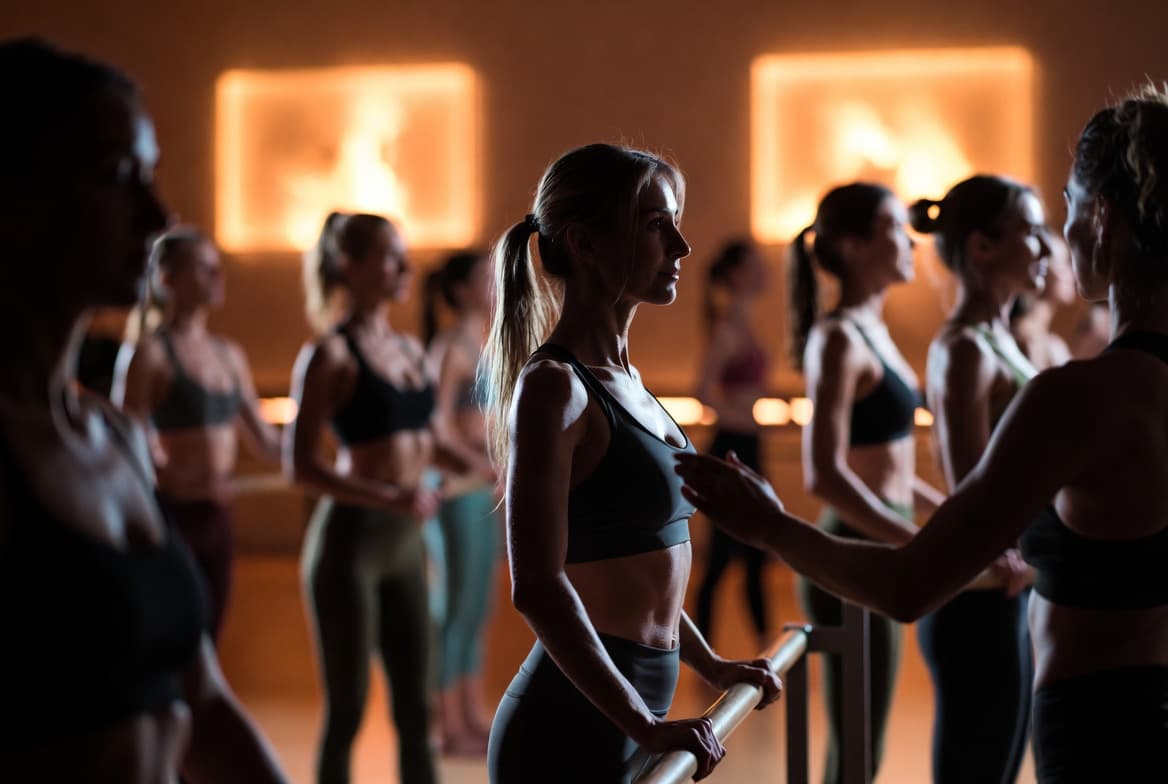
You've heard the buzz about barre, and you're curious. Maybe a friend raves about it. Maybe you saw a class on the schedule and wondered if you could actually do it.
The short answer: yes. Barre is one of the most beginner-friendly workout formats that exists. Here's everything you need to know before your first class.
What Happens in a Barre Class
A barre class is a 45–60 minute workout performed at a ballet barre (a horizontal railing mounted to the wall). The barre is there for balance — you're not doing ballet.
The class flows through sections targeting different muscle groups:
- Warm-up — Light movements to get your blood flowing
- Arms — Small, controlled movements with light weights (1–3 lbs) or no weights at all
- Thighs — Pliés, pulses, and isometric holds at the barre. This is the signature barre section.
- Seat (glutes) — Standing and kneeling work targeting your glutes from every angle
- Core — Planks, crunches, and stabilization on the mat
- Stretching — Flexibility work using the barre for support
Every section involves small, controlled movements repeated at high volume. You won't be jumping, running, or throwing heavy weights. The challenge comes from holding positions and pulsing until the muscle fatigues.
What Beginners Worry About (And Why They Shouldn't)
"I have no dance experience"
Barre borrows vocabulary from ballet (plié, relevé), but there's no choreography. No dance routines. No coordination required. The barre is a balance tool, not a dance prop. You'll learn every movement in class — the instructor demonstrates and then coaches you through.
"I'm not flexible enough"
Barre doesn't require flexibility — it builds it. Every class ends with stretching, and the movements themselves improve your range of motion over time. In a heated barre class at ALIVE Studios (85°F), the warmth helps your muscles stretch more easily from the start.
"I'm not fit enough"
Barre meets you where you are. Every exercise has modifications — a smaller range of motion, a lower hold, hands on the barre for extra support. Your first class won't look like the person next to you who's been doing barre for two years, and that's completely fine. The instructor will offer modifications throughout.
"I'll be the only beginner"
Every person in that room was a beginner once. Barre attracts a wide range of fitness levels — the format scales naturally because you control the depth of your movements, the amount of weight you use, and whether you add the advanced variations the instructor offers.
"It looks too easy"
This is the most common misconception. Barre looks gentle — small movements, light weights, ballet-inspired positions. Then you do it. By minute 20, your muscles will be shaking. By minute 40, you'll understand why people are addicted to it. The deceptive simplicity is what makes barre effective — it fatigues muscles through sustained tension, not explosive effort.
What to Wear
- Fitted, moisture-wicking clothing — You need to see your body positioning (important for form), and the instructor needs to see it too. Baggy clothes hide alignment issues.
- Grippy socks — Most barre studios require them. They prevent slipping on the floor and barre. ALIVE offers them for purchase if you don't have a pair.
- Sports bra / supportive top — You'll be moving in all planes, including inversions for core work
- Avoid cotton — It absorbs sweat and gets heavy, especially in heated barre. Polyester/spandex blends dry quickly and stay comfortable.
For a deeper guide on heated class clothing: What to Wear to Hot Yoga (applies to barre too).
How to Prepare
Day of:
- Hydrate throughout the day (don't chug water right before class)
- Eat a light meal 1–2 hours before
- Arrive 10–15 minutes early for your first class to get oriented
- Bring a water bottle and small towel
Mindset:
- It's okay to rest. If you need to shake out your legs during a hold, do it.
- Focus on your form, not the person next to you
- The "barre shake" (muscle trembling) is a good sign — it means the muscle is working to exhaustion
- Soreness the next day is normal, especially in your glutes and inner thighs
For ALIVE's complete first-class prep guide: How to Prepare for Your First ALIVE Class.
How Often Should Beginners Do Barre?
Start with 2 classes per week. This gives your muscles time to recover between sessions while building consistency. After 2–3 weeks, you can increase to 3–4 times per week if your body feels ready.
Barre is low-impact enough that soreness is primarily muscular (not joint stress), so you can do it on consecutive days once you're adapted. Many ALIVE members combine barre with other class formats:
- Monday: Spark (barre sculpt)
- Wednesday: Gravity (pilates for core)
- Friday: Particle (cardio barre)
- Weekend: Atom or Glow (hot yoga for flexibility)
Barre at ALIVE Studios
ALIVE offers three barre formats — so as a beginner, you can try each and find your fit:
Spark (Total Body Barre) — The best starting point. Slower pace, focus on form and isometric holds. Full-body sculpting.
Particle (Cardio Barre) — Faster pace, dance-inspired. Try this once you're comfortable with the basic barre positions.
Subatomic (Core Fit) — Core-focused. Great complement to the other barre classes.
All classes are heated to 85°F with 50% humidity. The coached format means an instructor is actively guiding and correcting your form — exactly what beginners need.
Ready to start? Your first month of unlimited classes lets you try every barre format at any of our three DFW locations.