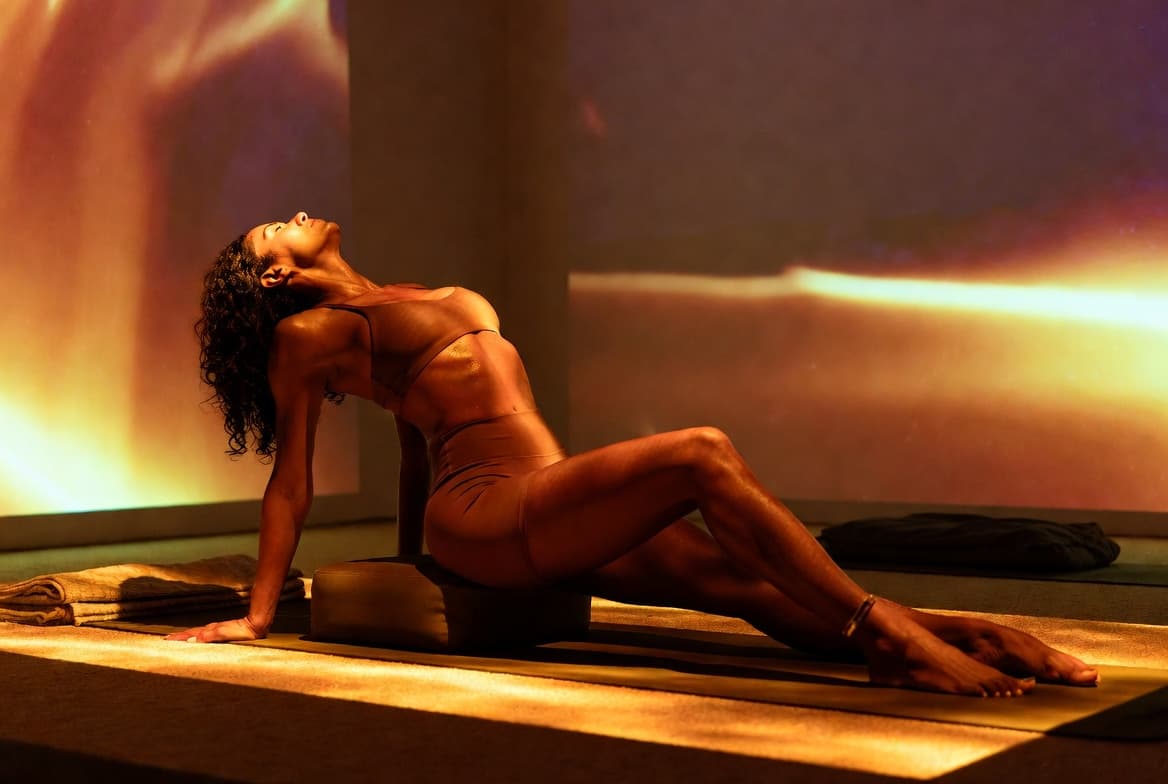
Most yin yoga happens in cool rooms. The slow pace, the long holds, the minimal muscle engagement — all of it points toward keeping the body cool. A traditional yin teacher will tell you heat is a yang quality, and yang has no place in a yin practice.
That's one view. It's not the only one.
Heated yin is a newer approach that treats temperature as a therapeutic variable, not a contradiction. When yin is practiced in a warm environment — typically 85–92°F — the effect on connective tissue changes. Holds become more productive. The body resists less. The nervous system downshifts faster. What changes isn't the goal of the practice. What changes is how quickly and how deeply you get there.
Here's what heated yin actually does, when it helps, and when room temperature is genuinely the better call.
What Changes in the Heat
Connective tissue is visco-elastic. That's a material-science term for something that behaves partly like an elastic band (stretches and returns) and partly like a thick liquid (flows under sustained load, but slowly). Temperature affects both behaviors. Warm visco-elastic material yields more to the same load than cool material does.
Translated into a yin pose: the same butterfly fold, held for the same three to five minutes, reaches a different depth in an 85°F room than in a 68°F room. The tissue is the same. The load is the same. What's different is the tissue's willingness to move under the load.
Three specific changes happen in heat:
Muscles relax faster. Yin depends on muscles staying soft so gravity can reach deeper tissue. In a cool room, muscles stay slightly braced — especially when you first settle into a pose. In a warm room, that bracing lets go sooner. You spend more of the five-minute hold actually working the fascia rather than waiting for the muscle to stop resisting.
Fascia becomes more plastic. Fascia is sheets of connective tissue that wrap muscle, bone, and organs. When fascia is cool, it's stiff and responds slowly to stretch. When it's warm, it becomes more plastic — it holds the lengthened shape after the load is released. This is why stretches after a hot shower feel different than stretches first thing in the morning. Heated yin takes advantage of the same phenomenon for a full practice.
Parasympathetic activation accelerates. Moderate warmth is mildly parasympathetic on its own — it cues the nervous system that the environment is safe and the body can downshift. Combined with yin's slow pace and long holds, the heat accelerates the transition into the calm, recovery-focused state that yin is supposed to produce. You arrive at the state faster and stay in it longer.
Why Not Just Go Hotter?
If some heat helps, why not more heat? Why not practice yin at 98°F like a hot vinyasa class?
Because the point of yin is stillness. You can't be still if you're overheating.
In hot vinyasa — 95–105°F — the heat is a stressor. It's part of the workout. You generate more heat through movement and the combined effect pushes the cardiovascular system. That's the intent. It's a yang practice, and the yang intensity works with the yang heat.
In yin, you're not generating heat through movement. You're barely moving at all. If the external heat is too high, it becomes uncomfortable in a way that pulls you out of the pose mentally. You start thinking about the heat instead of the hold. The nervous system stays slightly activated instead of fully relaxing. The parasympathetic benefit inverts.
The sweet spot for heated yin sits at 85–92°F. High enough to change the visco-elastic behavior of fascia and help muscles release. Low enough that the heat doesn't become its own distraction.
ALIVE's Aura (Yoga Calm), the yin-adjacent flow class, runs at 92°F / 50%, which sits in the productive range. Neutron (Yin Yoga), our traditional yin format at 85°F, is not on the schedule right now.
The Case for Heated Yin
Faster release for tight bodies. If you come to yin from an active lifestyle — running, cycling, lifting, hot yoga, sports — your connective tissue is probably tight in predictable places (hips, lower back, shoulders). Room-temperature yin works on this tightness, but slowly. Heated yin reaches it faster. A five-minute hold in a warm room can do what a ten-minute hold would do cool.
Better for beginners. The biggest barrier to yin isn't physical flexibility — it's the mental willingness to stay in a pose with sensation. New practitioners often fidget out of poses because the discomfort escalates before the tissue releases. In heat, the escalation is softer. Tissue yields sooner. Beginners stay in the pose. The practice becomes accessible instead of punishing.
Deeper parasympathetic shift. For people managing chronic stress, sleep issues, or nervous-system dysregulation, the combination of warmth plus stillness plus long holds produces a more pronounced calming effect than any single element alone. You leave a heated yin class noticeably more regulated than you would leave a cool one.
Complement to hot training. ALIVE members who take Atom, Photon, or Big Bang in the heat already have their bodies primed for warm practice. Dropping the temperature for a yin-style class like Aura keeps the recovery work in the same environmental range. The transition feels natural instead of jarring.
Less need for external warmth. In a cool yin class, practitioners bring layers, socks, and extra blankets to stay warm during long holds. In a heated class, you don't cool down because the room holds the warmth. The practice stays physically comfortable from start to finish.
When Room Temperature Is Better
Heated yin isn't the right call for everyone or every situation.
Pregnancy. The standard guidance for prenatal yoga is to avoid heated classes. This applies to yin as well. The physiological arguments around fetal heat stress and maternal core temperature regulation lead most obstetric-yoga specialists to recommend room-temperature or slightly cool environments. If you're pregnant, talk to your provider, and if you're practicing yin, practice it cool.
Certain heat sensitivities. Multiple sclerosis, some autonomic dysfunction disorders, and other heat-sensitive medical conditions can be aggravated by any heated practice. Room-temperature yin is the safer path.
Post-surgery or acute injury. During the recovery window for most surgeries and acute injuries, heat can worsen inflammation in specific tissues. The window for heat avoidance varies by injury — your medical provider's timeline is the reliable guide.
Very hot summer days. If you practice yin outdoors or at home in July, and your environment is already 85°F+ ambient, you don't need added heat. The point is practice, not thermoregulation. Use the conditions you have.
Preference for traditional yin. Some practitioners come to yin specifically for the cool, quiet, contemplative traditional form. That's a legitimate preference. If the warmth pulls your attention outward when your intent is fully inward, room-temperature practice serves you better. Neither is wrong.
Where Heated Yin Fits in Your Week
For most active people, one to three heated yin sessions a week is a reasonable target.
One class a week is an excellent recovery practice alongside three to five active workouts. Take it on a lighter training day or as the first practice after a hard effort.
Two to three classes a week moves yin into your regular recovery rotation. Good for people with chronic tightness, high stress, or aggressive training loads.
More than three a week is possible but rarely necessary. Yin-dominant weeks are useful during injury recovery, high-stress periods, or when actively trying to increase flexibility — but most practitioners find diminishing returns past three sessions weekly.
Pairing heated yin with other heated classes works well because the body stays acclimated to warmth. Common rotations:
- Atom on Monday, Aura on Tuesday. Hard yang practice followed by yin-style recovery.
- Wave on Wednesday, Aura on Thursday — power flow followed by gentle yin-adjacent movement.
- Particle on Saturday, Aura on Sunday. Cardio barre into recovery before the week starts.
Heated Yin at ALIVE Studios
ALIVE runs its yin-style practice warm, which almost no other studio in Dallas-Fort Worth does as a regular class format.
Neutron (Yin Yoga) — 85°F / 50% humidity. Traditional yin sequence, long holds at the edge of sensation. A true yin practice designed for connective-tissue work and deep recovery. Not on the schedule right now.
Aura (Yoga Calm) — 92°F / 50% humidity. Yin-adjacent flow. Gentler movement, longer holds than most flow classes, a calming intent throughout. Sits between vinyasa and yin — a good entry point for practitioners new to the slower end of yoga.
The warmth is managed by ALIVE's patented environmental controls. The system regulates dew point directly, not just temperature. In practice, this means the heat feels breathable. Sweat evaporates cleanly. The air doesn't feel heavy the way hot, wet studio air often does. The therapeutic warmth stays therapeutic — it doesn't become a second discomfort on top of the pose.
Classes are offered at our Plano, Southlake, and Las Colinas locations.
Try it. Your first month of unlimited classes is $24.99 and includes Aura and every other class on the schedule. One heated yin-style class will tell you whether the warmth does for your practice what we've described here.