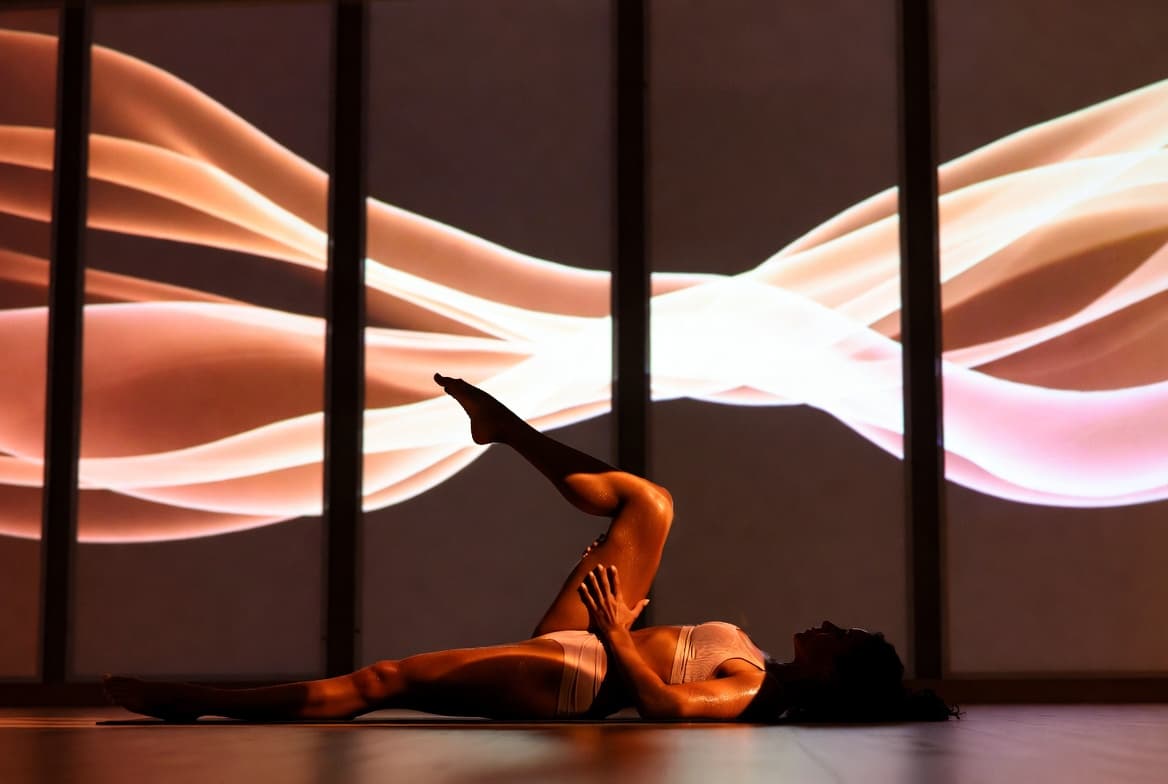
If you're looking into pilates, you've probably seen two very different setups: people on mats doing controlled floor exercises, and people on machines with springs and straps sliding back and forth.
Both are pilates. Both are effective. But they're different experiences that serve different goals. Here's an honest comparison.
What Is Mat Pilates?
Mat pilates is performed on a floor mat using your bodyweight as the primary resistance. Some classes add light props — resistance bands, small balls, blocks — but the foundation is you, the mat, and gravity.
Mat pilates was Joseph Pilates' original format. Every exercise requires you to stabilize your own body through core control. There's no machine assisting you — if your core isn't engaged, you can't do the movement properly.
Key characteristics:
- Bodyweight resistance
- Core must stabilize every movement independently
- Portable (needs only a mat)
- Accessible to all fitness levels with modifications
- Class-based format with instructor guidance
At ALIVE Studios, Gravity is the mat pilates offering — heated to 85°F for enhanced flexibility and muscle activation.
What Is Reformer Pilates?
Reformer pilates uses a machine (the reformer) that consists of a sliding carriage, springs for resistance, straps, and a foot bar. You push, pull, and hold positions on the carriage while the springs provide adjustable resistance.
The reformer was also created by Joseph Pilates, originally from a hospital bed rigged with springs to rehabilitate injured patients. Modern reformers are precision-engineered with variable spring tensions.
Key characteristics:
- Spring-based resistance (adjustable from light to heavy)
- The machine both assists and challenges you
- Requires specialized equipment (can't do it at home easily)
- Semi-private or small-group format (limited machines per studio)
- Higher price point (machine costs + smaller class sizes)
ALIVE does not offer reformer pilates. Our studio format is built around mat-based group classes with immersive technology and heat — a different approach.
Honest Comparison
| Mat Pilates | Reformer Pilates | |
|---|---|---|
| Resistance source | Bodyweight + gravity | Springs (adjustable) |
| Core demand | Higher (no machine assistance) | Variable (machine can assist) |
| Flexibility | Standard (enhanced in heated classes) | Good (spring assistance helps stretch) |
| Progressive overload | Change positions, add props | Change spring tension |
| Learning curve | Gentle (movements are intuitive) | Moderate (machine has a learning curve) |
| Class size | 10–30+ people | 5–12 people (limited by machines) |
| Cost | Standard class pricing | Premium ($30–60+ per class) |
| Accessibility | Any gym, studio, or home | Requires specialized studio |
| Variety | ~50 core mat exercises + variations | 100+ exercises using machine |
| Best for | Core strength, portability, group classes | Rehabilitation, progressive resistance, variety |
Where Mat Pilates Wins
Core activation is higher. Without a machine to assist or stabilize you, your core does all the work. Studies show mat pilates activates the deep core muscles (transverse abdominis) more than reformer exercises that allow the machine to share the load.
Accessibility. You need a mat. That's it. You can practice at home, at a gym, at a studio, on a hotel room floor. Reformer pilates requires a $5,000+ machine or a studio with one.
Scalability. Mat pilates works in large group classes. This means more scheduling flexibility, lower per-class costs, and the energy of a group environment. At ALIVE, Gravity classes run every 30 minutes — try finding that availability at a reformer studio.
Foundation building. If you're new to pilates, mat work teaches you to control your own body first. Many pilates instructors recommend starting with mat before moving to the reformer, because the mat builds the core awareness the reformer assumes you have.
Where Reformer Wins
Rehabilitation. The springs can assist movements, making exercises accessible for people recovering from surgery or dealing with significant mobility limitations. A physical therapist can adjust spring tension to match exactly what the patient can handle.
Progressive overload. The adjustable spring resistance lets you increase difficulty in precise increments. This is valuable for long-term strength progression beyond bodyweight.
Exercise variety. The reformer enables movements that aren't possible on a mat — standing work on the carriage, jumpboard exercises, long-stretch series. If variety motivates you, the reformer offers a broader movement vocabulary.
Upper body and leg work. While mat pilates is heavily core-focused, the reformer allows more targeted work for arms and legs using the straps and spring resistance.
The Third Option: Hot Mat Pilates
Here's what most comparisons miss — heated mat pilates is a different category.
Room-temperature mat pilates sometimes feels limited: tight muscles resist the movements, flexibility progress is slow, and the calorie burn is modest. Heat changes all three.
At ALIVE Studios, Gravity is heated to 85°F with 50% humidity:
- Flexibility is reformer-like — warm muscles stretch further, closing the flexibility gap between mat and reformer
- Calorie burn increases 20–30% — the heat elevates your heart rate throughout class
- Core activation deepens — warm muscles fatigue faster, so each hold produces more stimulus
- Injury risk drops — warm connective tissue is more pliable and forgiving
Heated mat pilates combines the core-strengthening advantages of mat work with physical benefits that approach what the reformer provides through mechanical assistance. The heat does naturally what the springs do mechanically — it makes your body more responsive.
Which Should You Choose?
Choose mat pilates if:
- Core strength is your primary goal
- You want schedule flexibility and group class energy
- You're building a pilates foundation
- You prefer all-inclusive pricing (one membership covers everything)
- You want to combine pilates with other heated classes (yoga, barre, HIIT)
Choose reformer pilates if:
- You're rehabilitating a specific injury (with medical guidance)
- You want machine-assisted progressive overload
- You prefer small, semi-private class settings
- Exercise variety is a top motivator
Choose both if: You can afford two memberships and want the best of each format. Many dedicated pilates practitioners do mat 2x/week and reformer 1x/week.
Hot Mat Pilates at ALIVE
Gravity (Pilates) — Mat pilates in 85°F with coached instruction. Your core does all the work. The heat does the rest.
Beyond pilates — Your ALIVE membership also includes barre, hot yoga, HIIT, meditation, and more. Reformer studios offer one format. ALIVE offers a complete fitness program.
Classes every 30 minutes at Plano, Southlake, and Irving.
Try it. Your first month of unlimited classes is the best way to experience heated mat pilates and decide for yourself.