Cash is the easiest gift to give and the easiest to lose. It lands in a checking account next to the car payment and the electric bill, and within a week it has quietly become groceries. Nobody did anything wrong. Money with no name on it goes where money is needed. A gift card is money with a name on it, and an ALIVE gift card names something most people won't buy for themselves: an hour between work and home that belongs to them.
That hour matters more than it sounds. Most of us leave work still carrying it: the meeting that went sideways, the email we didn't answer, tomorrow's list. Researcher Brené Brown compares the shift to a boat moving through a canal lock. The gates won't open until the water on both sides is level, and if you force it, the boat tips. A lot of us skip the lock entirely, and sit in the driveway scrolling until we can face the front door.
A class after work is a lock you can walk into. For 45 or 60 minutes the room does the leveling: the video and sound tell you what comes next, the light and the warmth change the pace, and there is nothing to decide and nobody to answer. You walk in with the day and walk out ready for home. With a class starting every 30 minutes until 9 PM Monday through Thursday, there's one on almost any drive home. That's what an ALIVE gift card gives.
Is a gift card better than cash?
Cash has a fair argument, and economists make it. When someone else picks your present, you usually value it at less than they paid, so the most efficient gift is money you can spend on whatever you'd have chosen yourself (Waldfogel, 1993). A gift card sits in between. Recipients still value one below its face, but the gap looks smaller than it does for a physical gift (Offenberg, 2007).
That argument assumes every dollar is the same as every other dollar. In practice, it isn't. When part of someone's money carries a label, they tend to spend it on what the label says, even when nothing stops them spending it on something else (Abeler and Marklein, 2017). Cash arrives with no label, so it takes the one already waiting in the account: bills. A gift card arrives with a label that says this part is for you.
What the label points to matters too. In studies of real gift exchanges, experiential gifts (things to do rather than things to keep) brought the giver and the recipient closer than material gifts did, whether or not they shared the experience. The lift came from how the recipient felt while using the gift, not while unwrapping it (Chan and Mogilner, 2017).
What happens between work and home?
Brené Brown gives the in-between a name in "Lock-In and Lock-Through Power," a chapter of her book Strong Ground that she shared on her Dare to Lead podcast. At work we lock in: we focus hard, push through, stay on. Getting home asks for something different, and she compares the shift to a boat passing through a canal lock. The chamber fills or drains until the water matches the next stretch of river, and only then do the gates open. Rush it and the water turns rough. Skip it and you either carry work's tempo into the kitchen or stall outside, still in the car, phone in hand.
Research on how people switch gears explains the feeling. When you move from one task to the next, part of your attention stays on the last one for a while. Researchers call it attention residue (Leroy, 2009). Clearing it at the end of the day has a name too: psychological detachment, actually stopping thinking about work. People who detach more in their off-hours are more satisfied with their lives and report less strain, and they're no less engaged when they're back at work (Sonnentag, 2012).
Why does moving help you leave work at work?
Brown makes a point that's easy to miss: deliberate recovery isn't passive. It's intentional, and it's often physical. She makes room for both: time to herself when she gets home, and time blocked on her calendar to work out.
A diary study of 126 working adults found the same pattern day to day. On days people exercised after work, their evening mood was more positive, and three things explained it: they detached from work, they felt a sense of belonging, and they felt good about their bodies (Feuerhahn, Sonnentag and Woll, 2014). Exercise didn't change how much negative mood people reported. It added good to the evening, which is a reasonable thing to ask of an hour.
What does an ALIVE class do for the transition?
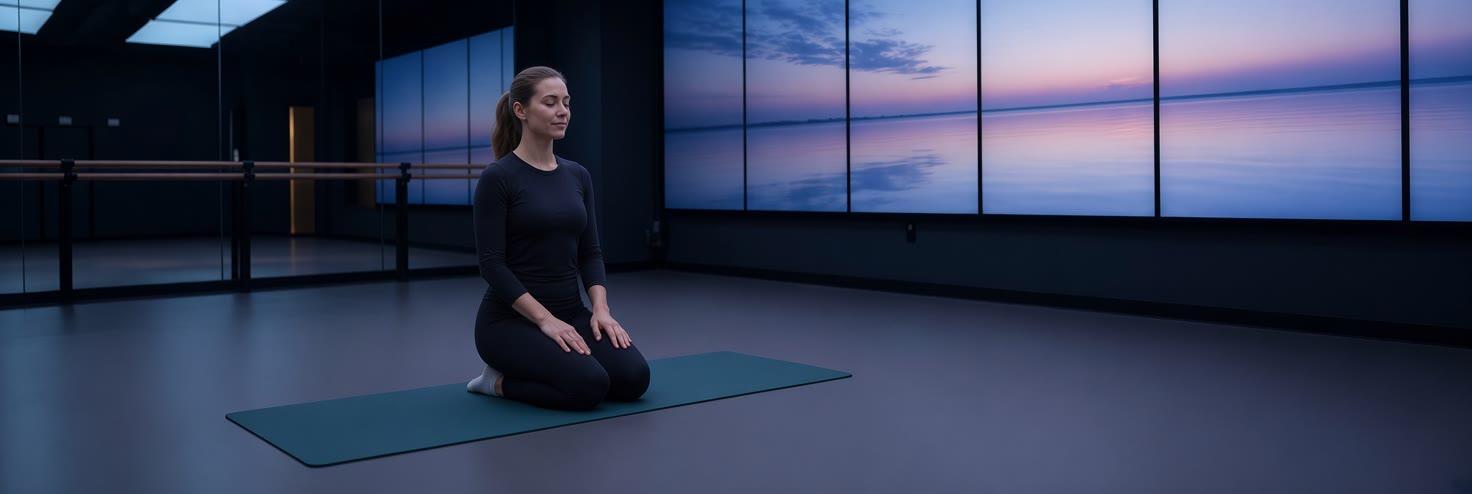
An ALIVE studio works like a lock chamber. Floor-to-ceiling video and sound lead the class, the lighting sets the pace, and our patented control system holds the heat and humidity steady. In an Immersive class there's no instructor at the front and nobody watching you. In a Coached class, a coach is there to help (here's how the two compare). Either way, for 45 or 60 minutes there's nothing to plan and nothing to answer.
You choose the level. Aura, Glow and Electron run at about 92°F and suit a day that has already taken enough. A harder class suits a day you'd rather sweat out. After a 45-minute class, stay for about ten minutes of guided meditation, Cosmic Meditation or Escape Velocity, carried by the room's video and sound. That's the gate opening. You walk out level with home.
You don't need anything left in the tank to go. Every class has levels, and showing up is the whole goal. If the person you're giving to has never been, their first class is easy to prepare for.
When does an after-work class fit?
Classes start every 30 minutes at all three studios: Plano, Southlake and Las Colinas. Monday through Thursday the last class starts at 9 PM, so there's one on almost any drive home. On Fridays and weekends the last class starts at 7 PM. If a meeting runs long, the next class is half an hour away. The schedule shows what's on at each studio.
How does an ALIVE gift card work?
- Any amount from $10 to $1,200, at alivestudios.fit/gifts.
- Give it your way. Print it to hand over in person, or send it by email or text.
- They redeem it on the gift cards page with a free account. The value becomes store credit that applies automatically to their next purchase: classes, class passes, a Trial Month or a membership, including monthly membership bills.
- It never expires, so it waits for the week they need it most.
If the person you're buying for would use more than a few classes, a membership might be the better gift.
How do you give it so it lands?
A gift card can feel like the fallback. Three small things make it the opposite.
- Say what it's for. Write it on the card: "For the hour between work and home." It turns an amount into a plan.
- Protect the hour. Offer to take pickup, dinner or the dog on their class night. Every lock has a keeper, and that's the part only you can give.
- Give it to the team. From a manager, a card for each person says something a bonus can't: leave it at the door tonight.
The bottom line
Cash is the efficient gift, and that efficiency is exactly why it disappears. A gift card puts a name on the money, and an ALIVE gift card names something hard to buy for yourself: a protected hour that lets the workday end before home begins. The research on recovery points the same way. Detaching from work matters, and moving after work helps you do it.
Give an ALIVE gift card this season. If you're the one who needs the reset, start with a Trial Month, explore the classes, or find your studio in Plano, Southlake or Las Colinas.
References
- Waldfogel J. The deadweight loss of Christmas. American Economic Review. 1993;83(5):1328-1336.
- Offenberg JP. Markets: gift cards. Journal of Economic Perspectives. 2007;21(2):227-238.
- Abeler J, Marklein F. Fungibility, labels, and consumption. Journal of the European Economic Association. 2017;15(1):99-127.
- Chan C, Mogilner C. Experiential gifts foster stronger social relationships than material gifts. Journal of Consumer Research. 2017;43(6):913-931.
- Brown B. Lock-In and Lock-Through Power. Dare to Lead podcast, September 23, 2025. From Strong Ground (Random House, 2025).
- Leroy S. Why is it so hard to do my work? The challenge of attention residue when switching between work tasks. Organizational Behavior and Human Decision Processes. 2009;109(2):168-181.
- Sonnentag S. Psychological detachment from work during leisure time. Current Directions in Psychological Science. 2012;21(2):114-118.
- Feuerhahn N, Sonnentag S, Woll A. Exercise after work, psychological mediators, and affect: a day-level study. European Journal of Work and Organizational Psychology. 2014;23(1):62-79.