Escape Velocity
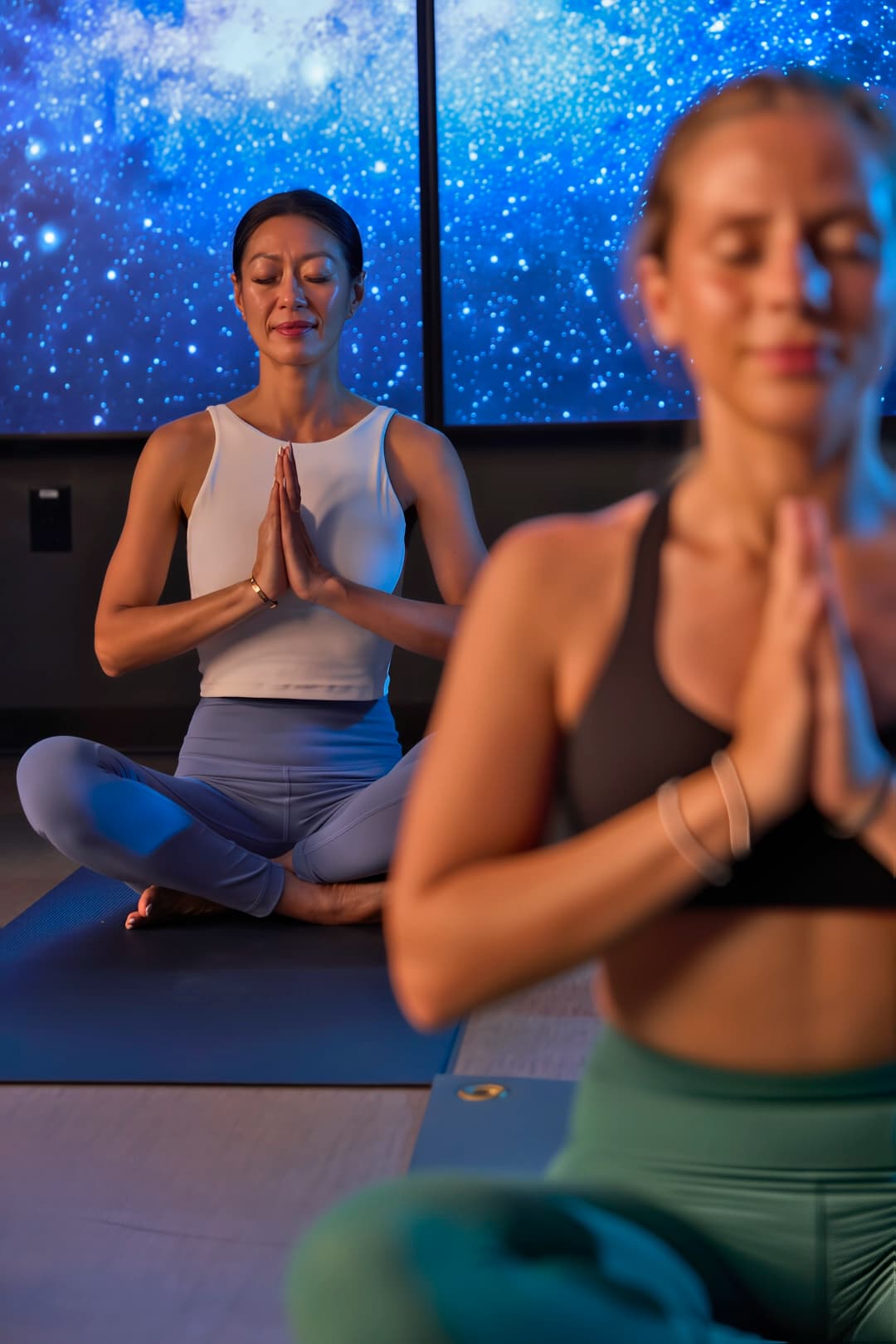
Escape Velocity is a guided immersive meditation that teaches you to meditate with your eyes open, then works on loosening the grip of whatever is holding you back. About ten minutes, after a 45-minute class or on its own.
Meditation is held after every 45-minute class on the schedule. If you are attending only the meditation, please join during the countdown.
Escape Velocity is a guided immersive meditation in two parts: first you learn to meditate with your eyes open, then you work on loosening the grip of whatever is holding you back. It runs about ten minutes and is carried entirely by the room's video and sound, so there is nothing to prepare and nothing to get right.
The name is the point. Escape velocity is the speed at which something breaks free of a gravitational pull, and this practice is built around the same idea applied to you. There are things with a hold on you: something you are afraid of, someone you are angry with, a worry that keeps its hand on your shoulder. The meditation does not ask you to solve any of them. It asks you to find where that hold actually lives in your body, and then to weaken it.
What Is Meditating With Your Eyes Open?
It is the skill the first half teaches, and it is easier than it sounds. You look straight ahead and then soften your gaze, pulling back from sharp focus. Do that and you notice you can still see what is to your left, and to your right, all at once. That is your full vision, and holding it is a genuinely different state of attention from the narrow focus most of us live in. The instruction that makes it land: your body follows your gaze. Open the gaze and you open the body with it. If your attention snaps back to the center, and it will, you take a breath, soften, and widen again. That is the practice, not a failure of it.
What About the Breathing?
The second technique is a low-belly breath with a brief hold. You empty your lungs completely, breathe into your low belly without letting your chest rise, hold, and then release as slowly as you can. Breathing low like this reaches the bottom of your lungs, which ordinary shallow breathing barely uses. Two honest cautions, both of which the meditation itself gives you. The extra oxygen can make you feel lightheaded, and there is no version of this where forcing it helps. No pushing, no overdoing, and never hold to the point of strain. You build the capacity over time or you do not build it at all.
What Is the Letting Go Part?
Three rounds of the same question, and the repetition is deliberate. You bring to mind the thing that is holding you back and find where you feel it: in your chest, in your stomach, behind your eyes. That physical feeling is the grip. Then two questions, asked plainly. Could you let it go. Would you let it go. Then you exhale, clear, and breathe again. Nobody asks you to answer out loud, and nothing about it requires you to have resolved anything. The aim is a weaker hold at the end than at the start.
How Is This Different From Cosmic Meditation?
Cosmic Meditation is a perspective practice: it widens the frame to 14 billion years so that your life reads as improbable and precious rather than small. Escape Velocity is a release practice, and it works close in, on one specific thing with a hold on you today. Both close on the same idea, which is what the studio is named for, but they get there from opposite directions. Take Cosmic when you want to feel your place in something vast, and this one when something particular is sitting on your chest.
Who Escape Velocity Is For
- Anyone carrying something specific. A fear, a resentment, a worry with a grip on it. This is the practice built for exactly that.
- People who cannot switch off with their eyes closed. Eyes-open meditation is a real alternative, and this teaches it from scratch.
- Newcomers to meditation. Guided the entire way, about ten minutes, and it hands you two techniques you can use anywhere afterward.
- Members already on the mat. It follows a 45-minute class, so trying it costs ten more minutes.
What to Expect
Sit upright with your legs crossed facing the mirror, or lie back if sitting is uncomfortable. The room is warm, so dress as you would for any heated class and bring water. Mat and towel are provided. Watch for the countdown on the screen: if you are joining only for the meditation, come in during the countdown, and if you do not plan to stay, please step out before it ends, which keeps the room settled once the practice begins.
How Often
Whenever you want it. It is short, it asks little of your body, and both techniques get better with repetition. The closing line is an open invitation: you can return to this meditation any time, and keep working on freeing yourself from the things that hold you back.
Where to Practice
Meditation sessions follow 45-minute classes on the schedule, so check the schedule for where and when.
Related reading: Why Does Yoga Feel Different When No One Is Watching? · Immersive vs Coached Classes · Fitness vs Health