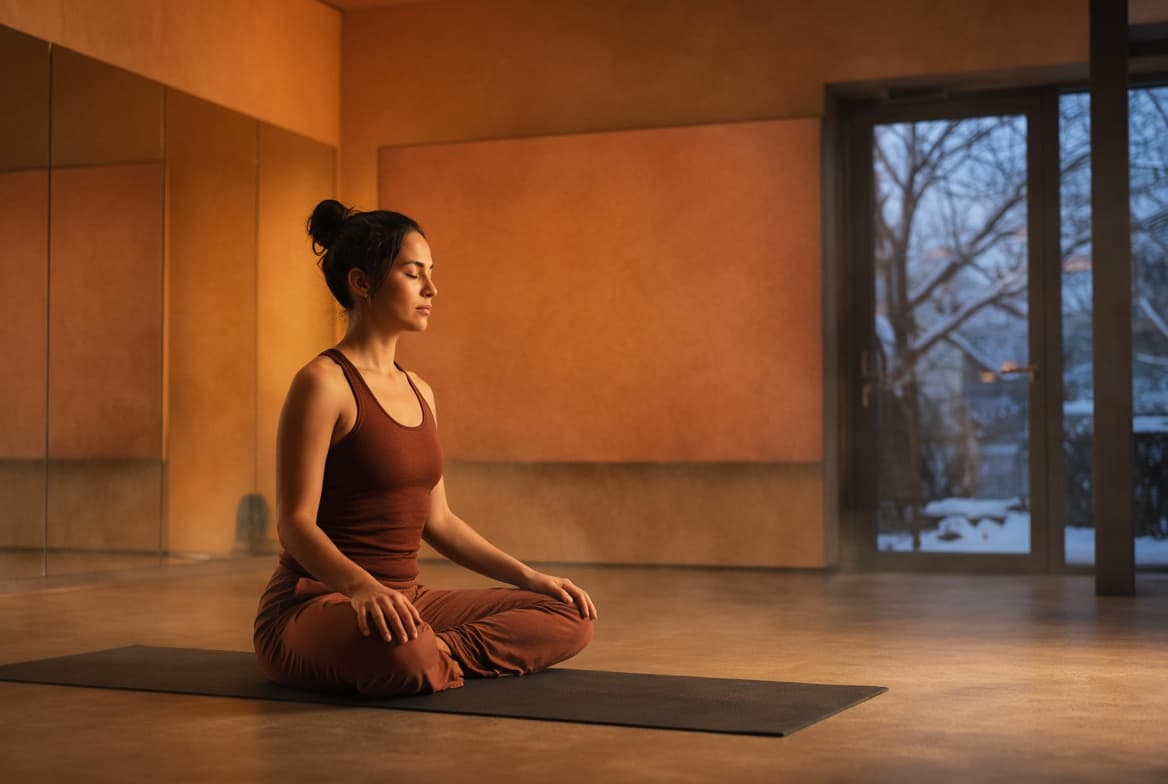
Seasonal depression, known clinically as seasonal affective disorder or SAD, is depression that returns at the same time every year. For most people it starts in late fall, is worst in the darkest months and lifts in spring. The leading explanation is light. Short days shift your body clock and change how your brain handles serotonin and melatonin. Bright light therapy and a winter-focused form of talk therapy have the best trial evidence. Yoga has a strong record against depression, and it puts back what winter takes: movement, routine and time with other people. In a Massachusetts General Hospital trial, 59% of people taking hot yoga classes cut their depression symptoms by half or more, against 6% on a waitlist. Exercise has also eased winter depression in small studies. That research covers depression in general rather than the seasonal kind, so yoga belongs alongside light and professional care, not in place of them. If your mood drops every winter, or it's getting in the way of sleep, work or relationships, talk with your doctor or a therapist. This article is education, not a diagnosis or a treatment plan.
What is seasonal depression?
A 1984 study that set out to describe the syndrome followed 29 patients whose depression arrived at the same point every year. They slept more, ate more and craved carbohydrates. Those are still the classic winter signs, along with low energy and pulling away from people.
Most people feel a milder version. In a random telephone survey in Montgomery County, Maryland, 92% of adults said their mood and behavior changed with the seasons and 27% called it a problem. Between 4.3% and 10%, depending on the definition, described impairment on the level of diagnosed SAD. The winter blues and seasonal depression are different things. Feeling slower in January is common. Losing weeks of normal life to it every year is a medical condition that deserves a proper evaluation.
Can you get seasonal depression in Texas?
Yes, though less often than up north, and researchers disagree about how much latitude matters. A 1990 survey of adults in New Hampshire, New York, Maryland and Florida found winter SAD significantly more common at the northern sites. A later review found that link held in North America but was small overall, and pointed to climate, genes and culture as bigger factors. A 2016 analysis of 34,294 US adults found no link at all between depression and season, latitude or sunlight. A condition that affects a few percent of people can vanish into an average that large, though, and the treatment trials below were run on people whose depression did follow the calendar.
Dallas still loses a lot of light. It gets about 10 hours of daylight at the December solstice against more than 14 in June, and once the clocks fall back on November 1 the sun sets before 5:45 until mid-January. If you work indoors from 8 to 5, most of your December daylight comes through a window.
What causes seasonal depression?
Light is the lead suspect, and research points to more than one route.
- Your body clock drifts. At Oregon Health & Science University, SAD symptoms tracked how far patients' internal clocks had slipped out of alignment. That supports the theory that late winter sunrises push the clock later and morning light pulls it back.
- Melatonin runs longer. In a National Institute of Mental Health study, 55 people with SAD produced melatonin, the hormone that signals night, for longer in winter than in summer. Their 55 matched volunteers showed no change.
- Serotonin turnover falls. In blood drawn from the brain's veins in 101 healthy men in Melbourne, serotonin turnover was lowest in winter and rose with that day's bright sunshine.
The melatonin researchers were careful to say their finding doesn't prove cause, and that holds for all three. These are strong leads, not a settled mechanism.
How is seasonal depression treated?
Bright light therapy is the most studied treatment. A 2005 meta-analysis found a large effect in SAD, on par with antidepressant trials. A 2020 meta-analysis of 19 trials found a smaller effect that was still significant, and rated the risk of bias moderate to high. In a Canadian head-to-head trial, 30 minutes of bright light each morning worked as well as an antidepressant, with 67% of each group responding.
The other strong option is cognitive behavioral therapy adapted for SAD, which includes scheduling enjoyable activities through the winter instead of withdrawing. In a University of Vermont trial of 177 adults, it matched light therapy during the episode. Two winters later, 27% of the therapy group had a recurrence, against 46% of the light-therapy group.
Light boxes are sold over the counter, but in these trials light therapy had a set intensity, timing and length. Set it up with your provider.
Does cold weather make seasonal depression worse?
The evidence points at the dark more than the cold, but it can't fully separate them. In a Danish study, 126 patients with winter depression rated their symptoms every two weeks from September to May for three winters. Their scores tracked sunshine, day length and temperature, and didn't track clouds, rain or air pressure. All three of those fall together in winter, so the study can't say what the cold adds on its own.
What cold clearly does is change your days. It keeps you indoors, where the light is much dimmer. The ordinary room light in one Finnish winter trial was 400 to 600 lux, and the light-therapy trials above used 10,000. It also keeps you still. Heat is the obvious counter. Our article on hot yoga and depression covers a 2016 trial in which raising body temperature eased depression for weeks. Nobody has tested heat for SAD, though, so treat a warm room in January as comfort, not treatment.
Does exercise help seasonal depression?
Winter cuts into movement. A review of 37 studies covering almost 292,000 people found activity rises and falls with the seasons, with bad or extreme weather a common reason people stop, and recommended indoor options for the cold, wet months. In North Texas, extreme weather means August as much as January.
That matters because exercise is one of the best-supported tools for depression in general, as our hot yoga and depression article lays out. For the seasonal kind, the evidence is thinner.
- In a Finnish winter trial, 120 office workers exercised two or three times a week in bright or ordinary light, or took a weekly relaxation class. Exercise in bright light eased oversleeping and carbohydrate cravings more than exercise in ordinary light, and beat relaxation on overall mental health. They were healthy employees, not patients.
- In a Russian study of women with winter depression, a week of daily midday cycling helped about as much as a week of bright light. There were nine people per group.
- A 2024 review found only six randomized trials of lifestyle changes for SAD, covering exercise, time outdoors, diet and sleep. All were small with a high risk of bias, and the reviewers couldn't say whether any of it works.
So for SAD specifically, exercise is promising and unproven.
Can yoga help seasonal depression?
Yoga's track record against depression is strong, and the movement it brings has helped winter mood in its own right.
- Yoga eases depression. In a 2023 Massachusetts General Hospital trial, 59% of adults with moderate-to-severe depression who took hot yoga classes, about one a week on average, cut their symptoms by half or more. On the waitlist, 6% did. In a smaller University of California, San Francisco trial, 90 minutes of hatha yoga twice a week eased mild-to-moderate depression more than an education class did.
- Movement helps through the dark months. In the Russian study above, a week of daily cycling helped women with winter depression about as much as a week of bright light, with nine people in each group. In an 8-week Finnish winter trial, 124 working-age adults did aerobics in bright light, aerobics in ordinary light, or relaxation and stretching in bright light. Both the exercise and the bright light eased depressive symptoms.
The case for yoga in winter rests on those two pieces: yoga eases depression, and movement eases winter mood. The step between them hasn't been studied. No trial has tested yoga in people diagnosed with SAD, and the only paper pairing the two is a 1990 theory article in Medical Hypotheses. The Finnish stretching group is the nearest thing to a yoga class in this research, and it always had the bright light, so its own effect can't be pulled apart. A mindfulness program tested on 46 SAD patients in a Dutch pilot did no better than usual care at preventing the next winter's episode. So use yoga as part of a winter plan, alongside light therapy or professional care, not in place of them.
What a class does is put several of the winter levers into one hour.
- Movement. It's the first thing cold weather takes, and it has the depression evidence behind it.
- A fixed time and place. Scheduling activities you value is part of the therapy that held up two winters later. A class isn't therapy, but showing up when you don't feel like it is the same move.
- Other people. Pulling away is a classic winter sign, and a class puts you in a room with people without asking you to talk.
- Warmth. A hot yoga room is warm when January isn't. Enjoy it, but don't count it as treatment.
What a class can't deliver is the light. No yoga studio is a light box. You can get daylight around one, though. In a Swiss study, SAD patients who walked outdoors for an hour every morning for a week did better than a group given low-dose artificial light. Half the walkers remitted, against a quarter of the others. It was small and short, but it's a good reason to choose a morning class and get outside on the way.
How do you use yoga for your mood this winter?
- Keep your care plan. A class adds to a light box, medication or therapy. It doesn't replace any of them.
- Book the slot, not the mood. Pick the same class time each week. In the Mass General trial, people improved on about one class a week, so the bar is low. With classes every 30 minutes and mats and towels provided, the hard part is getting out the door.
- Start gentle. Electron, Glow and Aura run at 92°F. Atom, our signature hot yoga class, runs at 98.6°F. After a 45-minute class you can stay for Cosmic Meditation or Escape Velocity, guided meditations of about ten minutes.
- Count showing up. On a heavy day, a gentle class you take beats a hard one you skip. That's the argument of The Only Goal Is Not Zero.
The bottom line
Most people feel the seasons in their mood. Seasonal depression is the far end of that range, where winter costs you weeks. Light is the best-supported cause, and light therapy and winter-focused CBT are the best-supported treatments. Yoga has trial evidence against depression, movement helps winter mood, and a class puts routine and other people back into the months that take them away. It hasn't been studied in SAD specifically. Use it as one part of a winter plan, alongside whatever care you need, and get daylight where you can.
If you want to build that habit before the shortest days arrive, ALIVE's 30 days of unlimited classes is an easy way to start. Begin with Electron or Glow, explore the class types, or find your studio in Plano, Southlake or Las Colinas.
This article is for general education, not medical advice, diagnosis or treatment. Yoga is not a treatment for seasonal affective disorder and is not a substitute for light therapy, talk therapy, medication or other professional care. If your mood changes with the seasons, talk with a doctor or mental health professional about what's right for you, and check with them before starting light therapy, especially if you have bipolar disorder or an eye condition, or take medication that makes you sensitive to light. Talk with a doctor before starting hot yoga if you have a heart or blood-pressure condition or are pregnant. If you're in crisis or thinking about harming yourself, call or text 988, the Suicide and Crisis Lifeline in the U.S., any time.
References
- Rosenthal NE, Sack DA, Gillin JC, et al. Seasonal affective disorder: a description of the syndrome and preliminary findings with light therapy. Archives of General Psychiatry. 1984;41(1):72-80.
- Kasper S, Wehr TA, Bartko JJ, et al. Epidemiological findings of seasonal changes in mood and behavior: a telephone survey of Montgomery County, Maryland. Archives of General Psychiatry. 1989;46(9):823-833.
- Rosen LN, Targum SD, Terman M, et al. Prevalence of seasonal affective disorder at four latitudes. Psychiatry Research. 1990;31(2):131-144.
- Mersch PP, Middendorp HM, Bouhuys AL, et al. Seasonal affective disorder and latitude: a review of the literature. Journal of Affective Disorders. 1999;53(1):35-48.
- Traffanstedt MK, Mehta S, LoBello SG. Major depression with seasonal variation: is it a valid construct? Clinical Psychological Science. 2016;4(5):825-834.
- Lewy AJ, Lefler BJ, Emens JS, Bauer VK. The circadian basis of winter depression. Proceedings of the National Academy of Sciences. 2006;103(19):7414-7419.
- Wehr TA, Duncan WC Jr, Sher L, et al. A circadian signal of change of season in patients with seasonal affective disorder. Archives of General Psychiatry. 2001;58(12):1108-1114.
- Lambert GW, Reid C, Kaye DM, et al. Effect of sunlight and season on serotonin turnover in the brain. The Lancet. 2002;360(9348):1840-1842.
- Golden RN, Gaynes BN, Ekstrom RD, et al. The efficacy of light therapy in the treatment of mood disorders: a review and meta-analysis of the evidence. American Journal of Psychiatry. 2005;162(4):656-662.
- Pjrek E, Friedrich ME, Cambioli L, et al. The efficacy of light therapy in the treatment of seasonal affective disorder: a meta-analysis of randomized controlled trials. Psychotherapy and Psychosomatics. 2020;89(1):17-24.
- Lam RW, Levitt AJ, Levitan RD, et al. The Can-SAD study: a randomized controlled trial of the effectiveness of light therapy and fluoxetine in patients with winter seasonal affective disorder. American Journal of Psychiatry. 2006;163(5):805-812.
- Rohan KJ, Mahon JN, Evans M, et al. Randomized trial of cognitive-behavioral therapy versus light therapy for seasonal affective disorder: acute outcomes. American Journal of Psychiatry. 2015;172(9):862-869.
- Rohan KJ, Meyerhoff J, Ho SY, et al. Outcomes one and two winters following cognitive-behavioral therapy or light therapy for seasonal affective disorder. American Journal of Psychiatry. 2016;173(3):244-251.
- Molin J, Mellerup E, Bolwig T, et al. The influence of climate on development of winter depression. Journal of Affective Disorders. 1996;37(2-3):151-155.
- Janssen CW, Lowry CA, Mehl MR, et al. Whole-body hyperthermia for the treatment of major depressive disorder: a randomized clinical trial. JAMA Psychiatry. 2016;73(8):789-795.
- Tucker P, Gilliland J. The effect of season and weather on physical activity: a systematic review. Public Health. 2007;121(12):909-922.
- Partonen T, Leppämäki S, Hurme J, Lönnqvist J. Randomized trial of physical exercise alone or combined with bright light on mood and health-related quality of life. Psychological Medicine. 1998;28(6):1359-1364.
- Pinchasov BB, Shurgaja AM, Grischin OV, Putilov AA. Mood and energy regulation in seasonal and non-seasonal depression before and after midday treatment with physical exercise or bright light. Psychiatry Research. 2000;94(1):29-42.
- Rothenberg M, Nussbaumer-Streit B, Pjrek E, Winkler D. Lifestyle modification as intervention for seasonal affective disorder: a systematic review. Journal of Psychiatric Research. 2024;174:209-219.
- Leskowitz E. Seasonal affective disorder and the yoga paradigm: a reconsideration of the role of the pineal gland. Medical Hypotheses. 1990;33(3):155-158.
- Fleer J, Schroevers M, Panjer V, et al. Mindfulness-based cognitive therapy for seasonal affective disorder: a pilot study. Journal of Affective Disorders. 2014;168:205-209.
- Leppämäki SJ, Partonen TT, Hurme J, et al. Randomized trial of the efficacy of bright-light exposure and aerobic exercise on depressive symptoms and serum lipids. Journal of Clinical Psychiatry. 2002;63(4):316-321.
- Nyer MB, Hopkins LB, Nagaswami M, et al. A randomized controlled trial of community-delivered heated hatha yoga for moderate-to-severe depression. Journal of Clinical Psychiatry. 2023;84(6):22m14621.
- Prathikanti S, Rivera R, Cochran A, et al. Treating major depression with yoga: a prospective, randomized, controlled pilot trial. PLoS One. 2017;12(3):e0173869.
- Wirz-Justice A, Graw P, Kräuchi K, et al. 'Natural' light treatment of seasonal affective disorder. Journal of Affective Disorders. 1996;37(2-3):109-120.