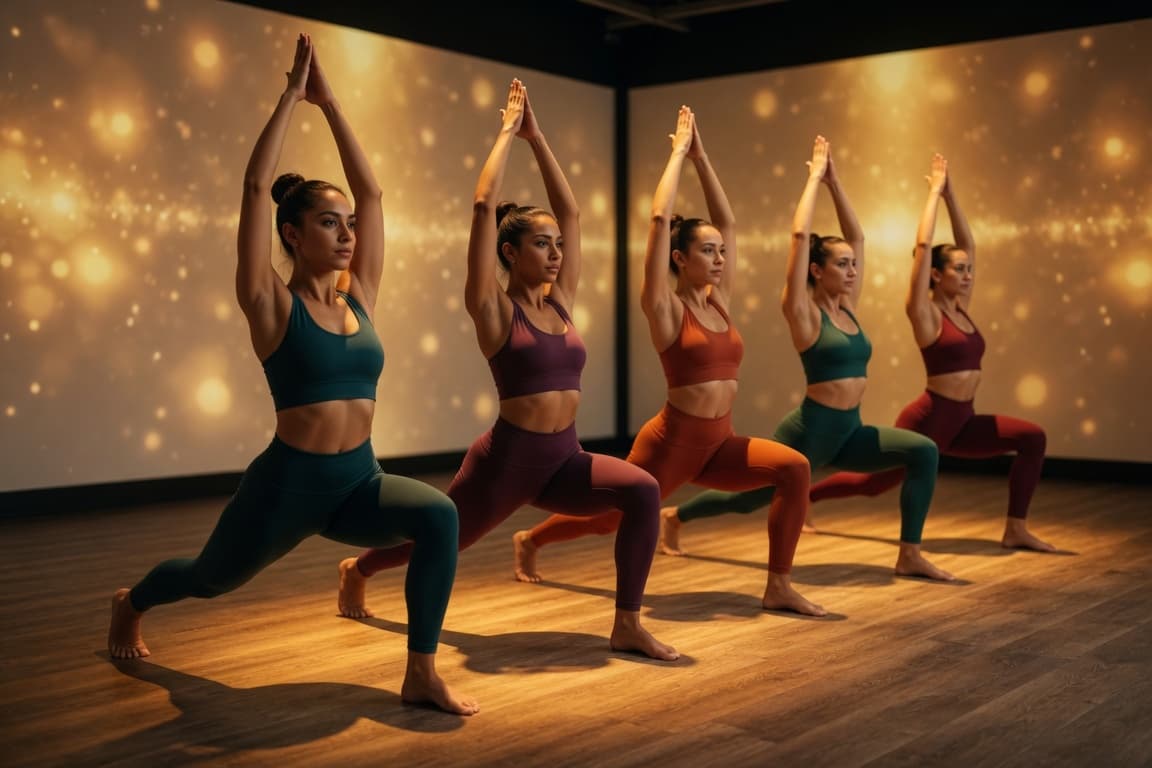
If you dance on a drill team, yoga is one of the most effective cross-training tools you can add to your week — and most dancers don't discover it until an injury forces them to. Drill team rewards extreme flexibility, explosive jumps, military precision, and the stamina to repeat all of it through a long competition season. Yoga trains the exact qualities those demands are built on: deep range of motion, controlled core strength, balance, recovery, and the calm focus that holds a routine together under stadium lights.
Here's how yoga works as cross-training for drill team, the specific injuries it helps prevent, and how to fit it around an already-packed practice schedule.
Why do drill team dancers need cross-training at all?
Drill team is a high-volume, high-repetition sport. Dancers run the same kicks, leaps, and formations dozens of times per practice, and the season stacks practices, football performances, and competitions on top of each other for months. That repetition builds incredible skill — and predictable imbalances.
Most drill routines load the same movements again and again: hip flexors fire constantly for high kicks, quads and calves absorb every jump landing, and the lower back arches repeatedly for layouts and kicks. The muscles that oppose those movements — hamstrings, glutes, deep core, and the small stabilizers around the hips and ankles — often get left behind. That imbalance is where overuse injuries start.
Cross-training fills the gaps the routine doesn't. Yoga is uniquely suited to it because it builds mobility and stability at the same time, with no added pounding on already-tired joints.
How does yoga improve flexibility for high kicks, leaps, and splits?
Flexibility is the headline benefit, and it's the one drill dancers feel first. High kicks, switch leaps, needle holds, and full splits all depend on open hips, long hamstrings, and a mobile spine. Yoga trains all three directly and — critically — trains active flexibility, the kind you can actually use mid-routine, not just passive range you only reach when something pushes you there.
- Hips and hamstrings: Poses like low lunge, pigeon, half-split, and standing forward folds open the hip flexors and lengthen the hamstrings that high kicks and leaps demand.
- Spine: Backbends and twists restore the extension and rotation that layouts, kicks, and quick formation changes ask for — while teaching you to move from the whole spine instead of cranking one vulnerable spot in the lower back.
- Ankles and feet: Balancing poses and toe stretches build the foot and ankle strength that clean relevés and controlled landings require.
Unlike static stretching alone, yoga links that range of motion to strength and control, so the flexibility you build holds up when you're tired in the fourth quarter.
Can yoga actually prevent the most common drill team injuries?
Yoga won't injury-proof anyone, but it directly targets the mechanics behind the injuries drill dancers see most:
- Hip flexor and hamstring strains — from overworked, never-lengthened muscles. Yoga restores length and balances the front and back of the hips.
- Lower back pain — from repeated hyperextension in kicks and layouts. Yoga teaches you to distribute that extension across the spine and brace with the core instead of collapsing into the lumbar spine.
- Knee and patellar stress — from jump landings. Stronger glutes and better hip-and-ankle alignment (both yoga staples) keep the knee tracking correctly on every landing.
- Ankle sprains and shin splints — from jumps and quick directional changes. Single-leg balance work builds the stabilizers that protect the ankle.
The common thread: most drill injuries come from imbalance and fatigue, and a regular yoga practice attacks both. Building heat-adapted, pliable muscle matters too — warm tissue strains less easily, which is part of why dancers respond well to heated practice.
How does yoga build the core strength and balance drill team demands?
Every turn, hold, kick line, and formation change is a balance and core-control problem. Drill judges reward stillness and control as much as height and flexibility — the dancer who can stop a movement cleanly scores better than the one who throws it.
Yoga builds exactly that control. Holding a warrior, a balancing pose, or a plank trains the deep stabilizing muscles to fire continuously, not in bursts. Single-leg poses force each side of the body to stabilize independently, which exposes and corrects the left-right differences that show up in a kick line. Over a few weeks, dancers notice steadier turns, cleaner balances, and the ability to hold a position without the small wobbles that cost points.
If a dancer wants to push core and stability training even further, Pilates is a natural companion to yoga — and ALIVE offers both.
Does yoga help dancers recover between practices and competitions?
Yes — and this is where yoga earns its place during the season, not just the off-season. Drill schedules rarely leave room for real rest, so recovery has to be active: something that increases blood flow, releases tight tissue, and calms the nervous system without adding more impact.
A gentler yoga session does all three. It flushes worked muscles, restores range of motion that tightens up after hard practices, and downshifts a body that's been in performance mode. Many athletes in other sports already use yoga this way for mobility and recovery — for dancers stacking performances week after week, that recovery is the difference between finishing the season strong and limping through it.
Can yoga calm performance nerves and sharpen focus?
Drill team is performed — under lights, in front of crowds and judges, with zero margin for a missed count. The mental side is as trainable as the physical one, and yoga is one of the best tools for it.
The breath work at the center of yoga is the same skill that steadies nerves before a performance: slow, controlled breathing tells the nervous system to settle, which keeps a racing heart and tight shoulders from sabotaging a routine. The focus a yoga class demands — staying present in a hard pose instead of letting the mind spin — is the exact attention a dancer needs to stay locked into choreography and counts. Dancers who practice yoga regularly often describe walking onto the field calmer, more focused, and more in control of their bodies.
Why does heated yoga work especially well for dancers?
Drill dancers are chasing range of motion most other athletes never need — full splits, oversplits, sky-high kicks. Heat is a real advantage there. In a heated room (ALIVE practices hot yoga between 90–105°F with controlled humidity), muscles warm faster and stretch further with less resistance, so dancers can safely explore the deep flexibility their sport demands. Warm, pliable tissue also strains less easily, and the elevated heart rate adds a conditioning benefit on top of the flexibility work.
New to the heat? It's more approachable than it sounds — start with what hot yoga actually is, what to wear, and what to expect in your first class. ALIVE provides mats and towels, so a first-timer just needs water and breathable clothes.
What drill team demands, and how yoga trains it
| Drill team demands | How yoga trains it |
|---|---|
| High kicks, leaps, splits | Hip, hamstring, and spinal mobility — active, usable range |
| Clean landings, fewer injuries | Glute and ankle strength, balanced hips, correct knee tracking |
| Steady turns and held balances | Deep core stability and single-leg balance work |
| Stamina through a long season | Active recovery: blood flow, tissue release, no added impact |
| Composure under the lights | Breath control and trained focus that steady nerves |
| Deep flexibility for kicks and splits | Heat-assisted stretching in a 90–105°F room |
Which ALIVE classes are best for drill team dancers?
Beyond a general heated practice, a few specific ALIVE classes line up especially well with what drill team demands — jumps, kicks, turns, stamina, and tight core control. Where to start depends on what a dancer most wants to improve:
- Spark (Total Body Barre) — 60 min, ~85°F — the top all-around pick. Light hand weights and resistance bands at high repetition build the posture, balance, glute and leg endurance, and core stability that carry a routine and protect against injury. The most drill-team-friendly class on the schedule.
- Particle (Cardio Barre) — 45 min, ~85°F — for performance stamina. Barre with dance and cardio elements builds the conditioning to get through a full routine, without heavy impact on already-tired joints.
- Gravity (Pilates) — 45 min, ~85°F — for cleaner lines and turns. Mat Pilates focused on core strength, stability, and mobility — the control behind a held balance and a clean line.
- Aura (Yoga Calm) — 92°F — for flexibility and recovery. A gentler, restoring practice that's ideal on off-days or during intense training and competition weeks.
Most dancers rotate through a couple of these — Spark or Particle to build, Gravity for control, Aura to recover — and let the week's training load decide the mix.
How to start: drill team cross-training in Southlake and Keller
North Texas takes drill team seriously, and two of the area's award-winning standout programs are right at home at ALIVE: the Emerald Belles in Southlake and the Indianettes at Keller High School. Both compete at a level the whole region recognizes, and the families behind them know what it takes to perform. Cross-training is part of that, and heated movement fits cleanly around a drill schedule: a session or two a week in the off-season to build flexibility and strength, and shorter recovery-focused sessions during the season to stay loose and injury-free.
ALIVE's Southlake studio is right in Emerald Belles country and an easy drive for Keller dancers too, with heated classes running throughout the day. Dancers can start with a beginner-friendly class, and the heat does a lot of the warm-up work — ideal for the deep flexibility drill demands.
A few simple ways to build it into a season:
- Off-season: 2 sessions a week to build range of motion, core strength, and balance from the ground up.
- In-season: 1 shorter, gentler session a week for recovery and to keep flexibility from tightening up.
- Competition week: a light, breath-focused session to stay loose and steady the nerves.
Try it for a month
The fastest way to feel what yoga does for drill is to get in the room. ALIVE's first month of unlimited classes lets a dancer try heated yoga, Pilates, and barre and find the mix that fits their training. Explore the class types or find the Southlake studio to get started.