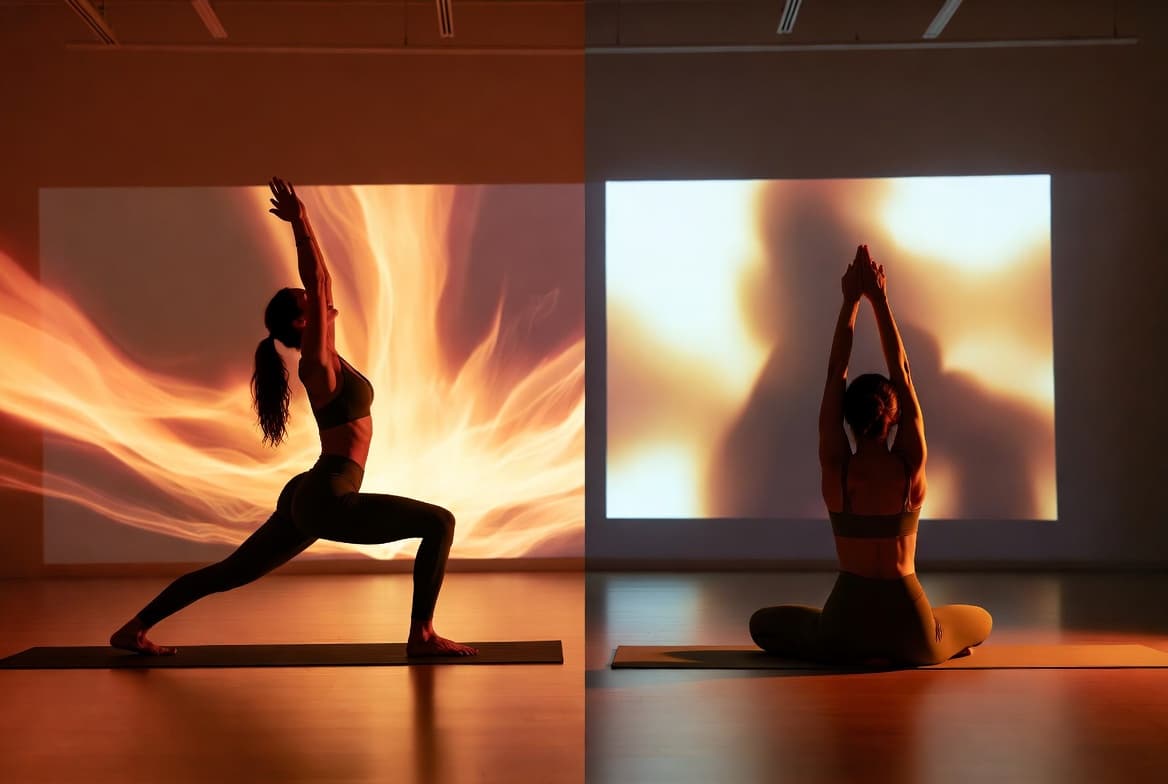
Yin and vinyasa sit at opposite ends of the yoga spectrum. Vinyasa is active, rhythmic, and warming — a flowing practice that builds heat and strength through breath-linked movement. Yin is slow, passive, and internal — a still practice that releases deep tissue through long, quiet holds.
Most people who come to yoga try vinyasa first. It looks like a workout, feels like exercise, and fits easily into a fitness routine. Yin comes later, often when practitioners realize vinyasa alone isn't reaching the tightness in their hips or the tension they carry in their lower back.
Here's how to decide which one fits your current goals — and why the honest answer is usually both.
The Core Difference
Vinyasa means "to place in a special way" — a linked sequence of poses connected by breath. You move continuously, transitioning from one shape to the next on each inhale or exhale. Muscles are engaged throughout. The body warms quickly. Heart rate stays elevated. A typical vinyasa class feels like a cardiovascular workout with a strong mobility and coordination component.
Yin is the opposite discipline. You hold long, passive shapes — three to five minutes each — with muscles deliberately soft. There's no flow between poses, no breath-linked movement, and no muscular effort. The target isn't cardiovascular fitness or muscle strength. It's the deeper layer underneath: fascia, ligaments, and joint capsules that need time and sustained load to respond.
One heats. The other cools. One activates. The other surrenders. They target different systems and produce different outcomes.
Side-by-Side Comparison
| Yin | Vinyasa | |
|---|---|---|
| Pace | Very slow, static | Fast, continuous flow |
| Hold length | 3–5 minutes per pose | A few breaths (5–10 seconds) per pose |
| Muscle engagement | Passive, muscles soft | Active throughout |
| Primary target | Connective tissue, fascia, joints | Cardiovascular, strength, coordination |
| Heat generated | Low (external heat helps) | High (body generates its own) |
| Intensity | Low physical / high mental | High physical / moderate mental |
| Sweat factor | Minimal | Significant |
| Equipment | Blocks, bolsters, blankets, straps | A mat and optional blocks |
| Calories | ~120–180 per 60 min | ~400–600 per 60 min (heated) |
| Mental demand | Stillness tolerance, acceptance | Focus, breath-movement coordination |
| Best for | Recovery, flexibility, stress release | Cardio, strength, energy, sweat |
| Soreness pattern | Deep, slow-developing tissue release | Muscular next-day soreness |
Choose Vinyasa If You Want To...
Move and sweat. Vinyasa generates heat through the body — the continuous flow spikes your heart rate and keeps it elevated for most of the class. A heated vinyasa class (like ALIVE's Wave at 92°F or Big Bang at 98.6°F) can burn 400 to 600 calories. If you want a workout that also counts as yoga, vinyasa is the clear pick.
Build strength. Vinyasa is load-bearing. Every chaturanga (the low pushup between flows), every plank-to-down-dog transition, every lunge is a strength exercise in disguise. Practice consistently for a few months and you'll feel stronger in your shoulders, arms, core, and legs — even though you never picked up a weight.
Coordinate breath and movement. Vinyasa trains the nervous system to link breath to motion. This carries into other sports — running, cycling, climbing, even high-intensity interval training. The breath control you build in vinyasa shows up everywhere else.
Feel energized and alert. Vinyasa activates the sympathetic nervous system — the "go" mode. You leave class wired in a focused way, warmed through, with a sense of having moved something. It's an excellent practice for mornings, midday resets, or before a busy evening.
Choose Yin If You Want To...
Recover from intense training. This is the #1 reason athletes, runners, and hot-yoga practitioners discover yin. The deep passive stretches reach tissue that active stretching doesn't. Tight hips from running, tight shoulders from cycling, tight hamstrings from lifting — yin addresses these at the connective-tissue level, not just the muscle.
Release stress and settle the nervous system. The long, still holds activate the parasympathetic system — the "rest and digest" mode. Regular yin practice lowers cortisol, improves sleep, and changes how you respond to daily stressors. The effect accumulates. After a few weeks, you'll feel the difference outside the studio as much as inside it.
Improve flexibility in a way that lasts. Active stretching improves muscle elasticity but doesn't always carry over. Yin's sustained loading of connective tissue produces flexibility gains that are slower to arrive but more durable. If you've plateaued in your flexibility from vinyasa alone, yin is often the breakthrough.
Meet mental discomfort with steadiness. Yin is as much mental training as physical. Staying in a pose for five minutes while sensation builds — and choosing to breathe through it instead of fidgeting out of it — is a skill that builds tolerance for discomfort in general. Many practitioners find this the most valuable part.
The Honest Answer: Do Both
Yin and vinyasa aren't competitors. They're complements — two halves of a complete practice.
Vinyasa without yin tends to produce tight hips, tight shoulders, and a nervous system that stays revved up. Muscles get strong, but connective tissue lags behind. You feel good for a few hours after class, then you feel tight again.
Yin without vinyasa misses the strength and cardiovascular benefits that active practice provides. The body softens but doesn't build. The stillness is restorative but can shade into sedentary over time.
Most people who do yoga long-term land in some version of both. A typical ALIVE member might:
- 3–4 vinyasa or flow classes per week (Wave for power flow, Glow for gentler flow, Atom for signature hot yoga)
- 1–2 yin-style classes per week (Aura, which carries yin's intent with some movement)
- Other strength or cardio work as desired (Particle barre, Universe HIIT, or outside training)
The yin serves the vinyasa. The vinyasa serves the yin. Together they cover what yoga is supposed to do.
Where Aura Fits In
One ALIVE class deserves special mention in this conversation: Aura (Yoga Calm).
Neutron is not on the ALIVE schedule right now. Aura (Yoga Calm) at 92°F is the yin-style class you can book today, and it is what the recommendations below point to. Aura isn't strict yin and isn't strict vinyasa. It sits between them — gentler pacing than a Wave or Atom flow, but still with some movement. Longer holds than most vinyasa classes but not as long as Neutron. It's the Atom sequence slowed down and warmed at a lower heat (92°F).
For vinyasa practitioners curious about yin but not ready for five-minute holds, Aura is the natural first step. For yin practitioners who want a little movement without losing the calming intent, Aura works the other way. Many members use Aura as the bridge between their more active days and their Neutron days.
Heated Yin and Heated Vinyasa at ALIVE
ALIVE runs both practices at heat. Different temperatures for different intents.
Vinyasa options:
- Atom (Signature Hot Yoga) — 98.6°F / 60% humidity. ALIVE's foundational vinyasa-style practice, intermediately paced.
- Big Bang (Hot Flow Yoga) — 98.6°F / 60%. Intense hot vinyasa.
- Photon (Hot Yoga Extra Heat) — 100°F / 65%. The Atom sequence in extra heat. Advanced.
- Wave (Power Flow Yoga) — 92°F / 50%. Advanced power flow.
- Glow (Flow Yoga) — 92°F / 50%. Gentler flow.
- Electron (Hot Yoga Lite) — 92°F / 50%. Atom sequence at lower heat.
Yin options:
- Neutron (Yin Yoga) — 85°F / 50%. Traditional yin. Not on the schedule right now.
- Aura (Yoga Calm) — 92°F / 50%. Yin-adjacent flow, between vinyasa and yin.
The heat is managed by ALIVE's patented environmental controls — dew point regulation rather than just temperature. In vinyasa classes, the heat amplifies the cardiovascular effect and deepens the stretches between flows. In yin classes, the warmth helps connective tissue release more fully in the long holds.
Three DFW locations: Plano, Southlake, and Las Colinas.
Try both. Your first month of unlimited classes includes every format. Take an Atom on Monday and an Aura on Tuesday and you'll feel the complementary effect within a week.