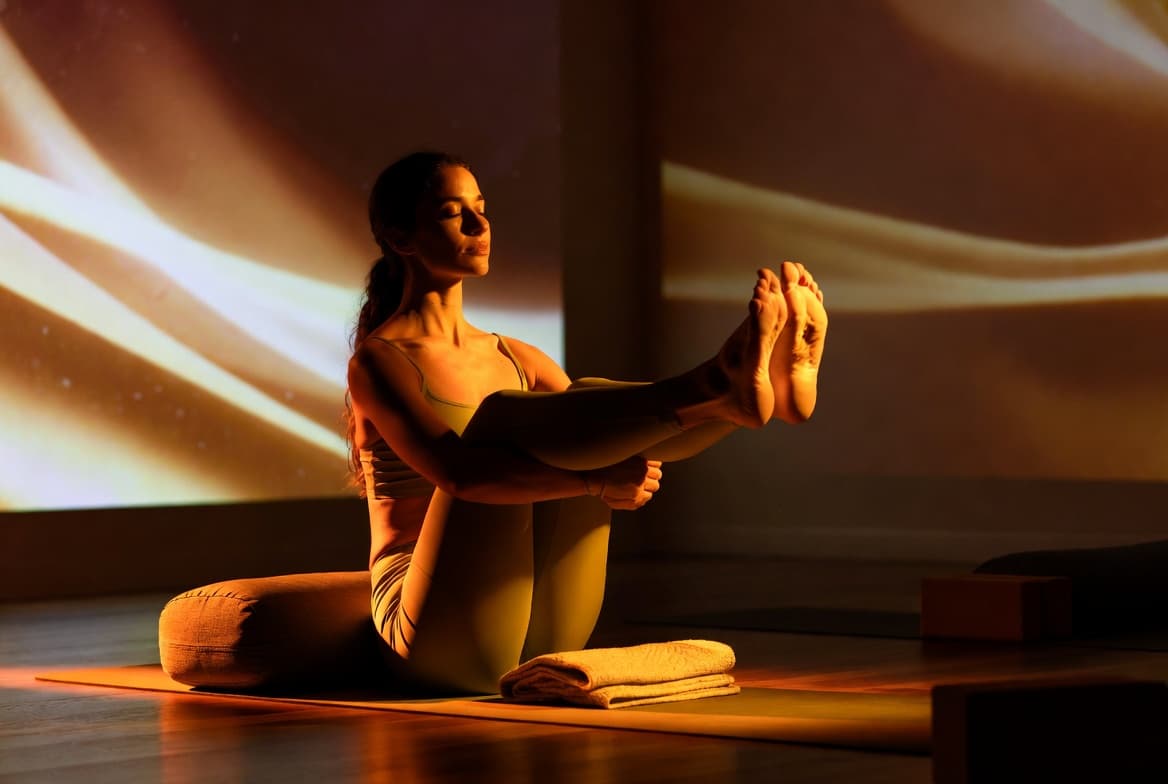
Yin yoga is a slow, quiet practice built around long, passive holds of mostly seated and reclined poses. You settle into each shape, stop actively engaging your muscles, and let gravity and time do the work. Holds last three to five minutes — sometimes longer — and the target isn't muscle. It's the deeper connective tissue underneath: fascia, ligaments, and joint capsules.
The feeling is distinctive. Yin doesn't burn like barre or build heat like vinyasa. It asks you to stay with a sensation that grows slowly, breathe through the edges of discomfort, and meet whatever comes up mentally while your body is still.
Where Yin Comes From
Yin yoga is relatively new compared to classical yoga traditions. It emerged in the late 1970s and 1980s, when martial arts teacher Paulie Zink blended Taoist yoga with Hatha yoga to create a slower, more internal practice. His student Paul Grilley then adapted the method into a Western format, with anatomy teacher Sarah Powers later codifying much of what's taught today.
The name comes from Taoist philosophy. Yang is active, warm, fast — the muscle work of a vinyasa class or a run. Yin is passive, cool, still — the quiet counterbalance. Yin yoga is meant to do what yang practices can't: reach the tissues that don't respond to rhythmic contraction and release.
How a Yin Class Works
A typical yin class runs 60 to 75 minutes and moves through 8 to 12 poses. There's no flow between them. You hold one, come out of it slowly, rest for a minute, then settle into the next.
Long holds. Three to five minutes per pose is standard. Some teachers go to seven or more. The length is the point — connective tissue doesn't respond to short stimulation the way muscles do. It needs time under sustained, gentle load.
Passive shapes. In yin, you're not holding yourself up through muscular effort. You let the floor, props, or bolsters take your weight. The muscles soften. Gravity finds the deeper tissues.
Breath at the edge. You find the pose at about 60–70% of your available range — not the deepest possible expression, but far enough to feel something. Then you breathe slowly and let the sensation expand on its own.
Props are standard. Blocks, bolsters, blankets, straps — whatever helps you settle in without forcing. A good yin teacher encourages prop use; there's no gold star for going deeper.
Silence or soft cueing. Most teachers talk less in yin than in other styles. The practice is internal, and verbal noise gets in the way.
Common Yin Poses
A yin sequence cycles through positions that target the hips, pelvis, lower spine, and shoulders. A few you'll see in nearly every class:
Butterfly — Seated with the soles of the feet together, knees dropped wide. You fold forward over the feet. Targets the inner thighs, hips, and lower back.
Dragon — A deep lunge with the back knee down. Opens the hip flexors and quadriceps of the back leg. Often held three to five minutes per side.
Sphinx / Seal — Reclined on your belly with forearms (sphinx) or straight arms (seal) propping you up. Compresses the lower back and stimulates the front of the spine.
Caterpillar — Seated forward fold with straight legs. A long, passive stretch for the entire back of the body, especially the spine and hamstrings.
Shoelace — Seated with legs crossed so the top knee sits directly above the bottom foot. One of the most effective hip openers in the practice.
Saddle — Reclined between your heels with knees bent, spine supported or fully on the floor. Targets the quadriceps and front of the hip. Intense — props are almost always used.
Who Yin Is For
People who train hard. Runners, cyclists, lifters, HIIT athletes, hot yoga practitioners — anyone whose body accumulates tension from repeated yang work. Yin is the recovery counterbalance. It restores range of motion and addresses the deep tissue stiffness that foam rolling and stretching don't fully reach.
People dealing with stress. The long holds and slow pace activate the parasympathetic nervous system — the "rest and digest" mode. Regular yin practice lowers cortisol, improves sleep, and changes how the nervous system responds to daily stressors.
People new to yoga. Yin doesn't require flexibility, strength, or prior experience. The poses are simple, the pace is forgiving, and every expression is optional. It's one of the most accessible entry points into yoga.
People managing chronic tension. Back tightness, hip tightness, shoulder tension — yin targets these areas in a way active stretching doesn't. The long holds encourage release at a depth most practices skip.
Yin isn't the right primary practice for everyone. People who want cardiovascular work, strength building, or high energy release won't get it from yin alone. But as a complement, it fills a gap no other practice addresses as directly.
Yin Yoga vs. Other Yoga Styles
| Yin | Vinyasa | Hatha | Restorative | |
|---|---|---|---|---|
| Pace | Very slow | Fast, flowing | Moderate | Very slow |
| Hold length | 3–5 minutes | A few breaths | 30–60 seconds | 5–20 minutes |
| Muscle engagement | Passive / off | Active throughout | Active | Fully supported, off |
| Primary target | Connective tissue, fascia | Cardiovascular, strength | Alignment, breath | Parasympathetic recovery |
| Heat generated | Low | High | Moderate | None |
| Mental focus | Stillness, acceptance | Flow, breath-movement link | Precision | Deep rest |
| Sweat factor | Minimal | High | Moderate | None |
The practice most often confused with yin is restorative yoga. Both are slow, both involve long holds, but they target different things. Restorative yoga is about complete rest — poses are fully propped so no tissue is under load. Yin deliberately introduces mild stress to connective tissue to stimulate adaptation.
For deeper comparisons, see Yin Yoga vs. Vinyasa and Yin Yoga vs. Restorative Yoga.
What to Wear and Bring
Layers. You cool down in yin — you're barely moving for an hour. Something long-sleeved for the end of class is a good idea, especially if the studio isn't heated.
Comfortable clothing. Loose or stretchy. Nothing that restricts when you fold forward or open your hips. Avoid anything with zippers or thick seams that press into you in long holds.
Props. Blocks, a bolster, a blanket, and a strap are standard. Most studios provide these. Bring your own if you have preferences.
Water. You won't sweat much, but long holds activate release processes. Hydration helps.
Patience. The real prep is mental. Expect stillness to feel harder than movement. That's part of what you're training.
Heated Yin: Why ALIVE Does It
Neutron is not on the ALIVE schedule right now. Aura (Yoga Calm) at 92°F is the yin-style class you can book today, and it is what the recommendations below point to. Most yin studios teach at room temperature or slightly cool. ALIVE runs its yin-style practice warm. Aura (Yoga Calm) at 92°F and 50% humidity is the class on the schedule today. Neutron (Yin Yoga), the traditional long-hold format at 85°F, is not currently offered.
The warmth isn't about sweating harder. It's about how fascia responds to heat.
Connective tissue is visco-elastic — it yields more to sustained load when it's warm. In a cool room, a five-minute hold reaches a certain depth. In an 85°F room, that same hold reaches further, and with less perceived effort. The muscle relaxation that yin depends on happens faster in warmth. The holds feel approachable instead of grueling.
This matters most for people new to yin, people with accumulated tightness from intense training, and people who've tried room-temperature yin and found the discomfort too sharp to stay with. Heated yin is more forgiving on the way in and more productive once you settle.
ALIVE's environmental control uses patented dew point management — the warmth feels clean and breathable, not heavy. Your body cools itself properly, so the heat stays therapeutic instead of oppressive.
For the full treatment of heated yin including when room temperature may be better, see Heated Yin Yoga: Why It Works.
Yin at ALIVE Studios
ALIVE's yin-style offering:
Neutron (Yin Yoga) — 85°F / 50% humidity. The full yin practice. Long holds, traditional sequence, targets connective tissue and fascia. Not on the schedule right now.
Aura (Yoga Calm) — 92°F / 50% humidity. Yin-adjacent. Gentler pacing with some flow. An entry point for vinyasa practitioners exploring yin territory, or for anyone who wants yin's calming intent with a bit of movement. Not strictly yin, but carries the same spirit.
Want the full picture on Aura? See Yin-Style Yoga at ALIVE: Is Aura Right for You?.
ALIVE runs these classes across our DFW locations: Plano, Southlake, and Las Colinas.
Ready to try it? Your first month of unlimited classes lets you explore Aura and every other class on the schedule.